

Table of Contents
- Why Hidden Safety Devices Matter for Urban Travel
- 1. Discreet Personal Alarms: Compact Protection That Fits Your Pocket
- 2. Smart Jewelry with Emergency Alerts: Wearable Safety in Stylish Form
- 3. Stun Guns and Pepper Spray Keychains: Dual-Purpose Self-Defense Kits
- 4. Hidden Pocket Clothing: Pickpocket-Proof Document and Cash Protection
- 5. Tactical Pens and Flashlights: Everyday Tools with Dual Purpose
- TSA Compliant Safety Tools: What You Can Actually Bring Through Airport Security
- How to Choose the Right Safety Device for Your Urban Travel Needs
Last Updated: August 23, 2026
Why Hidden Safety Devices Matter for Urban Travel
Solo urban travel carries real risks. Pickpockets work crowded transit stations. Unsolicited approaches happen in unfamiliar neighborhoods. The difference between feeling prepared and vulnerable often comes down to what you carry and how discreetly you carry it.
Hidden safety devices solve a specific problem: they provide genuine protection without broadcasting worry. A bulky tactical vest screams anxiety. A keychain that looks like a lipstick doesn't. This distinction matters because situational awareness includes not advertising yourself as an anxious target.
At Defense Divas Keychains, we track what actually works for urban travelers. The devices that gain real traction aren't the ones that look intimidating. They're the ones that blend into your everyday carry so seamlessly that you forget they're there until you need them. The best hidden safety devices are the ones you'll actually use because they don't feel like a compromise between protection and style.
Below, we'll walk through ten proven hidden safety devices, from discreet personal alarms to pickpocket-proof clothing, and explain which ones make sense for different urban scenarios. We'll also cover what you can legally bring through airport security, because a safety device confiscated at TSA is useless.
1. Discreet Personal Alarms: Compact Protection That Fits Your Pocket
A personal alarm emits an ear-piercing sound, typically 130 decibels or higher, designed to startle an attacker and draw attention from bystanders (the CDC). Most attackers want anonymity. A loud alarm destroys that instantly.
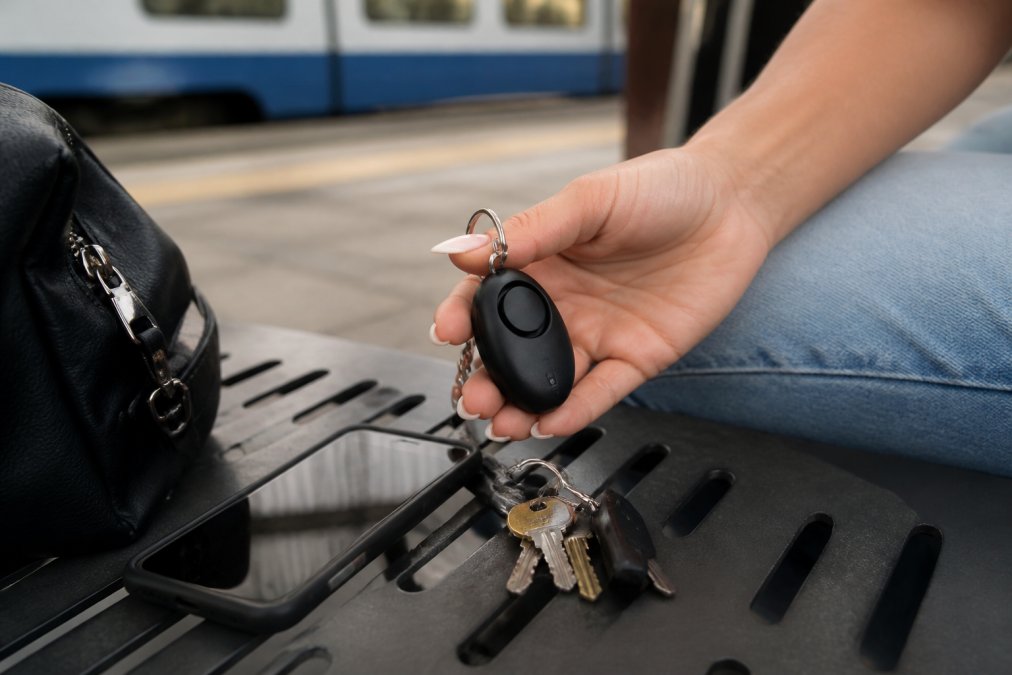
The best personal alarms are small enough to attach to a keychain or clip inside a jacket pocket. Tiny Protectors Personal Safety Alarm is roughly the size of a car key fob, features a 130dB alarm, and uses a simple pin-pull activation mechanism (peer-reviewed research). The rechargeable battery means you don't need constant replacement, just USB-C charging when it runs low.
Personal alarms are effective because they're passive. You're not required to aim, calculate distance, or engage physically. You pull the pin, the alarm sounds, and most situations de-escalate immediately. Bystanders hear the noise and look. An attacker loses the element of surprise.
The main limitation: a personal alarm only works if people are nearby to hear it. On an empty street at 3 AM, it's less effective than in a crowded transit station. It also doesn't contact emergency services directly. For that reason, many urban travelers pair a personal alarm with a smartphone app that can alert authorities.
2. Smart Jewelry with Emergency Alerts: Wearable Safety in Stylish Form
Smart jewelry embeds a hidden SOS button into bracelets, necklaces, or keychains that look like ordinary fashion pieces. InvisaWear and Flare Bracelet exemplify this approach.
When you press the hidden button, the device connects to your smartphone via Bluetooth and sends an alert to up to five pre-selected emergency contacts with your real-time GPS location. Some versions can also notify 911 directly through partnerships with services like ADT.
What separates smart jewelry from a basic personal alarm is the communication layer. A loud noise draws attention. A GPS-enabled alert gets actual help moving toward you. InvisaWear's ADT partnership means your location goes to emergency responders, not just to friends who might be across town.
The tradeoff is dependency on your smartphone. If your phone's battery is dead, the device won't function. If you're in an area with poor cellular signal, location data may be delayed or inaccurate. For urban travel, this dependency is manageable. Cities have dense cell coverage, and you're likely carrying your phone anyway.
3. Stun Guns and Pepper Spray Keychains: Dual-Purpose Self-Defense Kits
Stun guns and pepper spray represent active self-defense. You're not just drawing attention, you're creating a physical barrier between yourself and an attacker. Defense Divas Keychains offers stun gun and pepper spray functionality in a package that can be disguised as cosmetics.
The stun gun delivers an electrical charge designed to temporarily disable an attacker's nervous system, creating disorientation and muscle weakness. Pepper spray causes temporary blindness and respiratory irritation, forcing an attacker to retreat. Together, they offer redundancy: if one doesn't work or isn't accessible, the other is available.
The aesthetic design matters significantly. A device that looks like a lipstick sits openly in your purse without raising questions. A tactical-looking stun gun might get confiscated at venue security or attract unwanted attention. The rhinestone embellishment means it reads as fashion, not weaponry.
Critical legal note: Stun guns and pepper spray legality varies significantly by state and city (justice.gov). Some states ban stun guns entirely. Others allow them but restrict voltage or size. Before purchasing, verify the laws in your current location and any location you're traveling to. Carrying a prohibited device can result in confiscation, fines, or criminal charges.
4. Hidden Pocket Clothing: Pickpocket-Proof Document and Cash Protection
Hidden pocket clothing addresses a specific urban threat: pickpocketing. In crowded transit, markets, or tourist areas, skilled thieves can lift your wallet from a back pocket or outer bag without you noticing.
Clever Travel Companion produces pickpocket-proof garments, underwear, tank tops, and scarves, with concealed interior pockets designed to hold passports, credit cards, and cash. The pockets are positioned on the torso, making them inaccessible to anyone but you.
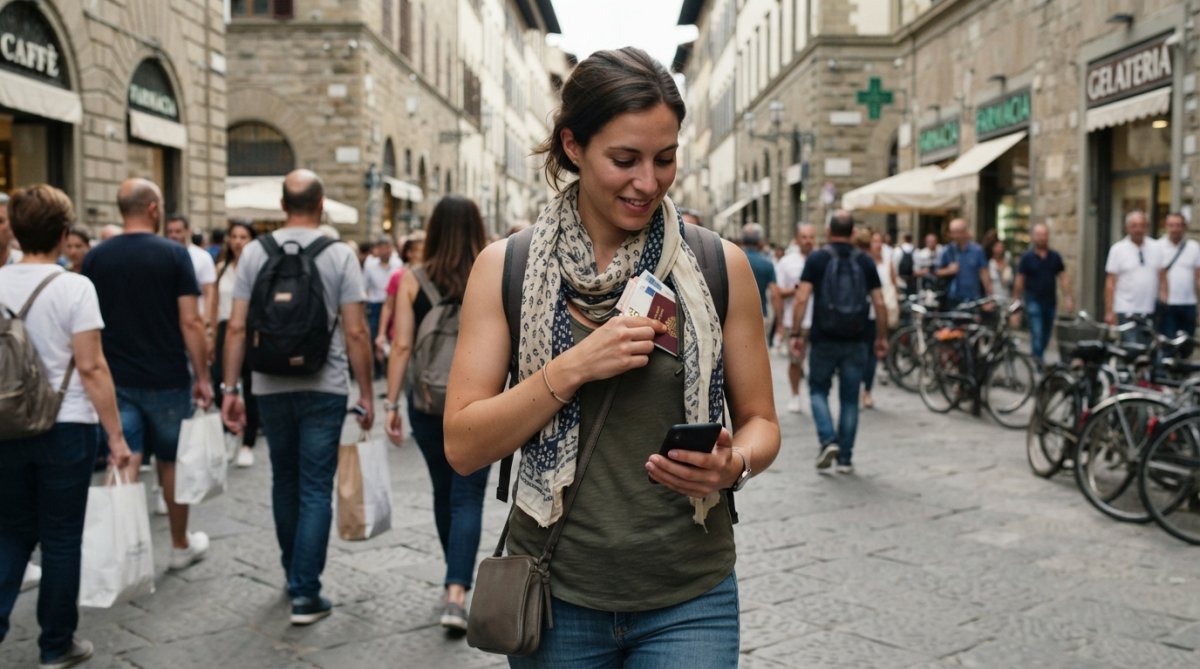
The advantage is elimination of the external target. A pickpocket's job becomes much harder when your valuable documents aren't in a visible or accessible location. Most pickpockets work in high-volume, low-risk environments and want easy targets. Hidden pocket clothing makes you a harder target than 95% of travelers.
The tradeoff is convenience. Accessing your documents requires lifting your shirt or removing a scarf, which you can't do discreetly in all situations. Many travelers use hidden pockets as a backup security layer rather than their primary storage, keeping everyday cash and cards accessible while storing their passport and backup credit card in a hidden pocket.
5. Tactical Pens and Flashlights: Everyday Tools with Dual Purpose
Tactical pens and flashlights occupy an interesting category: they're useful tools first, self-defense tools second. A tactical pen writes normally but features a durable metal body and a pointed end designed for striking or breaking glass. A tactical flashlight provides illumination but can temporarily blind an attacker with its bright beam.
The appeal is integration. You already carry a pen or flashlight. A tactical version doesn't add weight or bulk, it just upgrades something you'd own anyway. A tactical pen lives in your bag or jacket pocket without anyone knowing it's designed for self-defense.
Tactical pens work best in close-quarters situations where you need to create distance quickly. However, effectiveness depends on training and proximity. Tactical flashlights serve dual purposes more effectively. The illumination is genuinely useful for navigating dark streets or parking areas. The bright beam (often 500+ lumens) can disorient an attacker, giving you time to escape. The metal construction makes it a striking tool if needed. Unlike a pen, you can use the flashlight from a distance.
TSA Compliant Safety Tools: What You Can Actually Bring Through Airport Security
The TSA (Transportation Security Administration) maintains a list of prohibited items that cannot pass through airport security. Understanding what's allowed saves you the frustration of discovering your safety device is confiscated at the checkpoint.
What you CAN bring through TSA security:
- Personal alarms (non-explosive sound-based devices)
- Smart jewelry and wearable alert devices with no prohibited components
- Tactical pens (as writing instruments)
- Tactical flashlights (permitted as flashlights)
- Hidden pocket clothing (no restrictions)
- Kubotan keychains (permitted as keychain tools)
What you CANNOT bring through TSA security:
- Pepper spray and tear gas (prohibited in carry-on and checked baggage)
- Stun guns and tasers (prohibited in carry-on and checked baggage)
- Self-defense sprays of any kind
This creates a real problem for travelers who rely on pepper spray or stun guns: you must leave them at home or ship them separately to your destination. Some travelers mail their devices ahead to hotels or use local alternatives at their destination.
Important: TSA rules are federal, but individual airports and airlines sometimes enforce stricter rules. Before traveling, contact your specific airport or airline to confirm. A device that's technically TSA-compliant might still be prohibited by your airline's specific policy.
For urban travel that involves flying, your best options are personal alarms, smart jewelry, tactical pens, flashlights, and hidden pocket clothing, all of which pass TSA screening without issue.
How to Choose the Right Safety Device for Your Urban Travel Needs
Choosing the right hidden safety device depends on three factors: your threat assessment, your legal environment, and your comfort level with different tool types.
Threat assessment: What specific risks concern you most? Pickpocketing suggests hidden pocket clothing. Unwanted approaches suggest a personal alarm or smart jewelry. Close-quarters assault suggests pepper spray or a stun gun (where legal). Most urban travelers face multiple threat types, which is why layering devices makes sense: a personal alarm for drawing attention, hidden pockets for document security, smart jewelry for location tracking.
Legal environment: Before purchasing any device, verify legality in your state and any states you'll be traveling to. Stun guns and pepper spray have the most variable legality. Personal alarms and hidden pocket clothing are legal everywhere. Smart jewelry and tactical tools are legal in all states but might be restricted by specific venues.
Comfort level: Some people are comfortable with active self-defense tools like pepper spray. Others prefer passive devices like alarms that don't require physical engagement. The best device is the one you'll actually carry and, if needed, use.
For most urban travelers, a practical combination looks like this:
- A personal alarm for immediate attention-drawing in public spaces
- Hidden pocket clothing or a hidden pocket bag for document security
- Smart jewelry or a smartphone app for emergency location tracking
- Optionally, pepper spray or a stun gun if legal in your area and you're comfortable with active self-defense
| Device Type | Best For | Legal Everywhere | TSA Approved | Requires Training |
|---|---|---|---|---|
| Personal Alarm | Drawing attention in crowded areas | Yes | Yes | No |
| Smart Jewelry | Emergency location tracking | Yes | Yes | No |
| Pepper Spray | Close-quarters self-defense | No (varies by state) | No | Minimal |
| Stun Gun | Physical deterrent | No (varies by state) | No | Minimal |
| Hidden Pocket Clothing | Pickpocket prevention | Yes | Yes | No |
| Tactical Pen | Everyday carry with backup capability | Yes | Yes | Yes |
| Tactical Flashlight | Illumination with deterrent capability | Yes | Yes | No |
Defense Divas Keychains specializes in the aesthetic side of this equation. Defense Divas Keychains offers stun and pepper spray functionality in a package that looks like cosmetics rather than a weapon. The rhinestone design means it doesn't advertise itself as a self-defense tool, which is exactly the point of hidden safety devices. For travelers who want active self-defense tools that don't compromise on style, Defense Divas' approach to fashion-forward designs solves the problem of carrying protective gear that actually matches your aesthetic.
Hidden safety devices work because they remove the false choice between looking stylish and feeling protected. The devices that gain real adoption are the ones that integrate seamlessly into your everyday carry. Whether you choose a personal alarm, smart jewelry, hidden pockets, or a combination of tools, the goal is the same: you move through urban environments with genuine protection and genuine confidence. Start with the threat that concerns you most, verify legality in your area, and add layers as needed. The best safety device is the one you'll actually keep with you.
=== FAQ ANSWERS (audit these too, same rules) ===
[1] Q: Are personal safety keychains and hidden safety devices legal for travel? A: Legality varies by state and destination. Stun guns and pepper spray are restricted or prohibited in some states and many jurisdictions. Personal alarms and tactical pens are generally legal nationwide, but always check your destination's laws before traveling. TSA compliant safety tools like personal alarms are permitted through airport security, but stun guns and pepper spray are prohibited in carry-on and checked baggage. Research your specific route and destination regulations before purchasing any self-defense kit.
[2] Q: What makes a personal safety keychain actually effective in an emergency? A: Effectiveness depends on the device type and your ability to access it quickly. Personal alarms work by drawing attention and startling an attacker, relying on bystander intervention. Stun guns and pepper spray require close proximity and proper technique. Smart jewelry with GPS and emergency alerts connects you to help rather than deterring an attacker directly. The most effective approach combines multiple tools: a loud alarm for immediate attention, a way to contact emergency services, and a backup self-defense option. Your confidence in using the device matters as much as the tool itself.
[3] Q: How do I know which TSA compliant safety tools will actually make it through airport security? A: Personal alarms, tactical pens, and smart jewelry without stun or spray functions are generally TSA compliant. Stun guns and pepper spray are always prohibited in both carry-on and checked baggage. Hidden pocket clothing and RFID-blocking accessories pass security without issue. To be certain, check the TSA website or contact your airline before traveling. When in doubt, pack questionable items in checked baggage only, or purchase them at your destination. Keep documentation or packaging that shows the device's purpose and features.
[4] Q: What's the difference between discreet and tactical safety devices for urban travel? A: Discreet devices blend into everyday carry and don't signal that you're carrying protection, like a lipstick stun gun or hidden pocket clothing. Tactical devices are designed to be visible and functional, like a tactical flashlight or kubotan keychain, and may draw attention. For urban travel, discreet options work better when you want to avoid drawing attention or looking like a target. Tactical gear suits situations where you want to project awareness and preparedness. Many travelers combine both: discreet primary tools and tactical backups for specific scenarios.
Frequently Asked Questions
Are personal safety keychains and hidden safety devices legal for travel?
Legality varies by state and destination. Stun guns and pepper spray are restricted or prohibited in some states and many jurisdictions. Personal alarms and tactical pens are generally legal nationwide, but always check your destination's laws before traveling. TSA compliant safety tools like personal alarms are permitted through airport security, but stun guns and pepper spray are prohibited in carry-on and checked baggage. Research your specific route and destination regulations before purchasing any self-defense kit.
What makes a personal safety keychain actually effective in an emergency?
Effectiveness depends on the device type and your ability to access it quickly. Personal alarms work by drawing attention and startling an attacker, relying on bystander intervention. Stun guns and pepper spray require close proximity and proper technique. Smart jewelry with GPS and emergency alerts connects you to help rather than deterring an attacker directly. The most effective approach combines multiple tools: a loud alarm for immediate attention, a way to contact emergency services, and a backup self-defense option. Your confidence in using the device matters as much as the tool itself.
How do I know which TSA compliant safety tools will actually make it through airport security?
Personal alarms, tactical pens, and smart jewelry without stun or spray functions are generally TSA compliant. Stun guns and pepper spray are always prohibited in both carry-on and checked baggage. Hidden pocket clothing and RFID-blocking accessories pass security without issue. To be certain, check the TSA website or contact your airline before traveling. When in doubt, pack questionable items in checked baggage only, or purchase them at your destination. Keep documentation or packaging that shows the device's purpose and features.
What's the difference between discreet and tactical safety devices for urban travel?
Discreet devices blend into everyday carry and don't signal that you're carrying protection, like a lipstick stun gun or hidden pocket clothing. Tactical devices are designed to be visible and functional, like a tactical flashlight or kubotan keychain, and may draw attention. For urban travel, discreet options work better when you want to avoid drawing attention or looking like a target. Tactical gear suits situations where you want to project awareness and preparedness. Many travelers combine both: discreet primary tools and tactical backups for specific scenarios.