

Table of Contents
- What Counts as a Safety Keychain? Types and Legal Categories
- Are Safety Keychains Legal in All States? The Short Answer
- States Where Self-Defense Keychains Are Illegal or Restricted
- Can You Take Safety Keychains on Airplanes? TSA Rules Explained
- Municipal Ordinances vs. State Law: Why Your City Matters More
- How to Use a Safety Keychain for Self-Defense
- Legal Liability and Defensive Use: What You Should Know
- Frequently Asked Questions
Last Updated: September 22, 2026
What Counts as a Safety Keychain? Types and Legal Categories
Safety keychains are compact sets of personal protection items attached to a keyring, and the law treats them very differently depending on what's on the ring. At Defense Divas Keychains, we hear one question more than any other: are safety keychains legal in all states? The honest answer starts with categories, because a personal safety alarm and a metal kubaton sit on opposite sides of most state statutes.

Here's the key distinction. Deterrent tools make noise or light. Impact tools strike. One is almost always fine. The other can be a crime to carry.
Deterrent Tools: Alarms and Flashlights
Personal safety alarms are small devices that emit a loud sound when you pull a pin or press a button. They're legal to carry nearly everywhere, including most college campuses and many workplaces.
Mini flashlights count as ordinary tools. Nobody classifies a flashlight as a weapon.
These items are "deterrents" because they draw attention and buy you time to get away. They don't injure anyone.
Impact Tools: Kubotans and Resin Weapons
An impact weapon is designed to strike. That's where laws tighten fast.
- Kubatons: short metal or plastic sticks on a keyring, often pointed
- Resin weapons: hard plastic self-defense tools shaped for striking
- Brass knuckles: metal rings worn over the fingers, banned in many states
Some states classify kubatons and resin tools as prohibited weapons. Others treat them as ordinary keychain gear. There's no national rule.
Are Safety Keychains Legal in All States? The Short Answer
No. Safety keychains are not legal in all states, because legality depends entirely on what's attached to the ring. Deterrent items like alarms and flashlights are legal almost everywhere. Impact tools like kubatons, resin weapons, and anything resembling brass knuckles face restrictions in several states and outright bans in a few.
The word "safety keychain" isn't a legal term. No state statute defines it. So a prosecutor looks at the individual object, not the marketing label.
That means two people can carry identical-looking keychains and face completely different outcomes. One carries an alarm and a flashlight. The other carries a pointed metal stick. Same ring. Different legal category.
A common mistake is assuming a product's "self-defense" label protects you. It doesn't. Weapon classification is about design and function, and courts look at how an item is built.
States Where Self-Defense Keychains Are Illegal or Restricted
Restrictions cluster in a handful of states, and the pattern is consistent: impact tools get banned, deterrents don't. But the details matter more than the headlines, because the difference between a legal keychain and a misdemeanor often comes down to a single statutory phrase.
Here's how the categories typically break down:
| Item | Legal Status | Notes |
|---|---|---|
| Personal safety alarm | Legal nearly everywhere | No weapon classification |
| Mini flashlight | Legal everywhere | Ordinary tool |
| Window breaker / seatbelt cutter | Legal nearly everywhere | Safety tool, not a weapon |
| Kubaton (metal) | Restricted or banned in some states | Often classed as impact weapon |
| Resin striking tool | Restricted or banned in some states | Same category as kubaton |
| Brass knuckles | Banned in most states | Classic prohibited weapon |
That table is a starting point. The real risk lives in how states define terms like "dangerous weapon," "deadly weapon," and "prohibited weapon." A kubaton isn't usually named in a statute. Instead, it gets swept into a broader category, and whether it does depends on how a prosecutor reads the object's design and how an officer describes it in a report.
A few patterns worth knowing:
Aqua Defense Safety Keychain Set with →
- Massachusetts treats many impact weapons as prohibited and requires a license to carry certain self-defense items. A kubaton on a keyring can be charged as a dangerous weapon.
- New York has a broad "dangerous instrument" statute that can capture striking tools, and New York City adds its own layer on top (more on that below).
- California regulates "metal knuckles" and certain impact weapons under its Penal Code, though the exact scope has shifted with case law and legislative amendments.
- Illinois restricts metal knuckles and similar items, and Chicago's municipal code is stricter than the state's.
- New Jersey has some of the tightest restrictions on self-defense weapons in the country, and its "weapons" definitions are broad enough to catch items that look harmless elsewhere.
A common pattern is that the item's primary design controls. A flashlight with a pointed bezel is still a flashlight in most states. A metal stick marketed as a "self-defense tool" is not.
Can You Take Safety Keychains on Airplanes? TSA Rules Explained
No, you generally cannot bring impact tools through airport security. The TSA bans kubatons, brass knuckles, and similar striking weapons in carry-on bags. Personal alarms and flashlights are usually fine.
What typically clears security:
- Personal safety alarms
- Mini flashlights
- Keyrings and wristlets
- Window breakers and seatbelt cutters (check with your airline)
What typically does not:
- Kubatons and resin striking tools
- Brass knuckles
- Any item security staff judges to be a weapon
Municipal Ordinances vs. State Law: Why Your City Matters More
Your city can be stricter than your state, and that's the part people miss. A tool that's legal under state law can still violate a municipal ordinance where you live or travel, and in practice, most legal trouble with self-defense keychains happens at the city level, not the state level.
- New York City has its own administrative code with weapons provisions that are stricter than New York State's, and enforcement at transit hubs and in certain districts is active.
- Chicago has a municipal code that restricts weapons in ways that go beyond Illinois state law, particularly around carry in public spaces.
- Washington, D.C. operates under its own weapons regulations that differ from neighboring jurisdictions in Maryland and Virginia, a real issue for commuters who cross lines daily.
- Los Angeles and San Francisco have local ordinances that layer on top of California's state rules, especially around schools, transit, and public buildings.
- Boston adds local restrictions on top of Massachusetts's already-strict state law.
Beyond cities, other authorities can restrict carry:
- Transit systems, many public transit agencies ban weapons on buses and trains regardless of state law.
- College campuses, most campuses ban weapons, and some ban items the state allows. A student carrying a kubaton legally under state law can still face expulsion.
- Workplaces, private employers can prohibit items on their property, and "no weapons" policies often sweep in anything that looks like one.
- Public buildings, courthouses, federal buildings, and many municipal buildings screen for weapons and will confiscate items that are legal on the street.
- Search your state statutes for "prohibited weapons" and "impact weapon"
- Search your city or county code for "weapons" and "carry restrictions"
- Call your local police non-emergency line and ask directly
- Check campus or workplace policy if that's where you'll carry it
How to Use a Safety Keychain for Self-Defense
The best self-defense tool is the one you can reach in two seconds. That's the whole principle. A keychain buried at the bottom of a bag is useless when it matters.
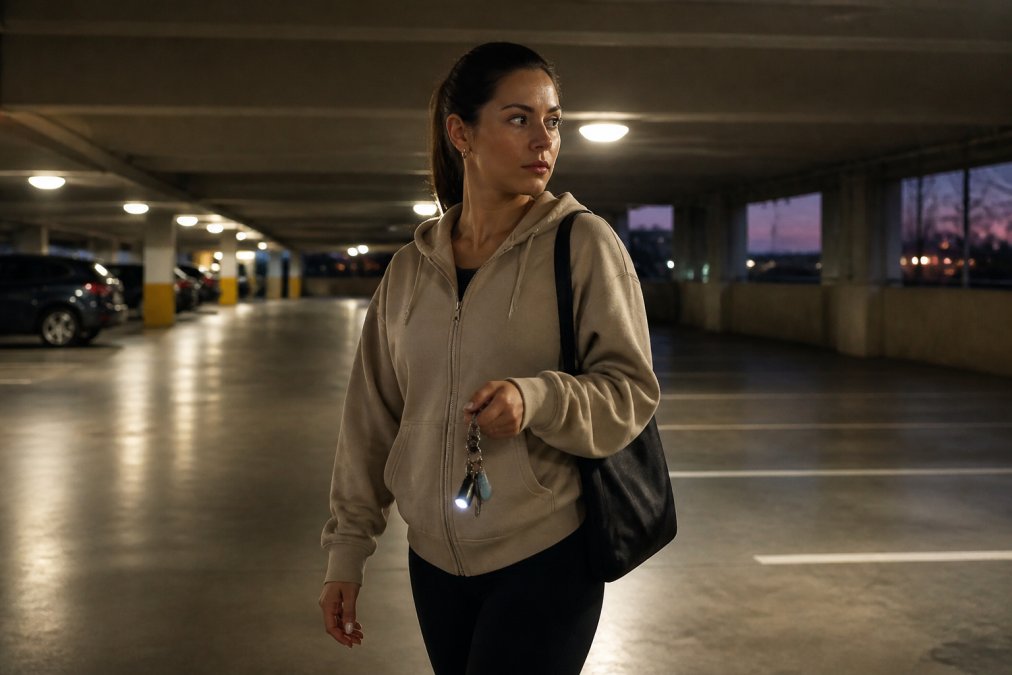
Here's what actually works in practice:
- Keep it in your hand, not your bag. Keys out, alarm ready, walking to your car.
- Learn your alarm's trigger by feel. You should be able to pull the pin without looking.
- Use the flashlight to scan ahead. Light deters more than people expect.
- Make noise early. An alarm at the first sign of trouble beats one pulled too late.
- Create distance, then leave. The goal is escape, not confrontation.
Legal Liability and Defensive Use: What You Should Know
What that means in practice:
- Proportional force matters. A deterrent that helps you escape reads very differently than a strike that injures.
- Impact tools invite harder questions. If you used a kubaton, expect scrutiny of whether it was legal to carry at all.
- Your carry choice becomes evidence. An illegal item can turn a clean self-defense case into a charge against you.
Carrying an item that's illegal in your city can hurt you even if you never use it. Possession alone can carry penalties, and it weakens any self-defense claim you might later need to make.
Our own product pages say it plainly: customers are responsible for knowing and following all local, state, and federal laws about the items they carry. We mean it. Check before you carry, and check again if you move.
Frequently Asked Questions
Are kubotan keychains legal in all states?
No. Kubotans and similar impact weapons are banned in states like California, Massachusetts, New York, and Illinois. Some states classify them as prohibited weapons regardless of size. Even in states where they are legal, local municipal ordinances can restrict them further. Always check your city code before carrying any impact tool.
Can I carry a self-defense keychain on a plane?
TSA allows personal safety alarms and mini flashlights in carry-on bags. Pepper spray is limited to one 4-ounce container in checked baggage only and must have a safety cover. Kubotans, brass knuckles, and impact weapons are prohibited in both carry-on and checked bags. Rules can change, so check the TSA website before you fly.
Do I need a permit to carry a self-defense keychain?
Permits are not required for personal safety alarms or mini flashlights in any state. Pepper spray may require a permit in some states like Massachusetts and New York. Impact weapons like kubotans typically do not have a permit process; they are either legal to carry or outright prohibited. Check your state statutes and local ordinances for specifics.
Which states have strict laws regarding self-defense weapons?
California, Massachusetts, New York, Illinois, and New Jersey have the strictest laws. California bans metal knuckles and leaded canes. Massachusetts prohibits kubotans and similar impact weapons. New York classifies many self-defense keychains as criminal possession of a weapon. Always review state statutes and municipal ordinances before purchasing.