

Table of Contents
- The Short Answer: What TSA Says About Tactical Pens
- Why TSA Treats Tactical Pens Differently Than Standard Pens
- Understanding the TSA Prohibited Items List
- Checked Baggage Rules for Tactical Gear and Pens
- What Happens If TSA Confiscates Your Pen at the Checkpoint
- Traveling with Self-Defense Keychains: Safer Alternatives
- Smart Travel Tips for Your Tactical Gear
- Final Take on Flying with Tactical Pens
- Frequently Asked Questions
Last Updated: September 5, 2026
The Short Answer: What TSA Says About Tactical Pens
Are tactical pens allowed through airport security? The direct answer is yes, tactical pens are generally permitted in carry-on luggage because they are classified as writing instruments, not weapons. Unlike knives, firearms, or impact tools such as batons, a standard tactical pen does not appear on the TSA's prohibited items list. However, the final decision always rests with the TSA officer at the checkpoint.
At Defense Divas Keychains, we hear this question constantly from customers who carry self-defense tools daily. The nuance most travelers miss is that the TSA's rules focus on intent and design. A pen that looks like a pen, writes like a pen, and has a discreet glass breaker tip is treated as a dual-use item, passing through security screening without issue in the vast majority of cases.
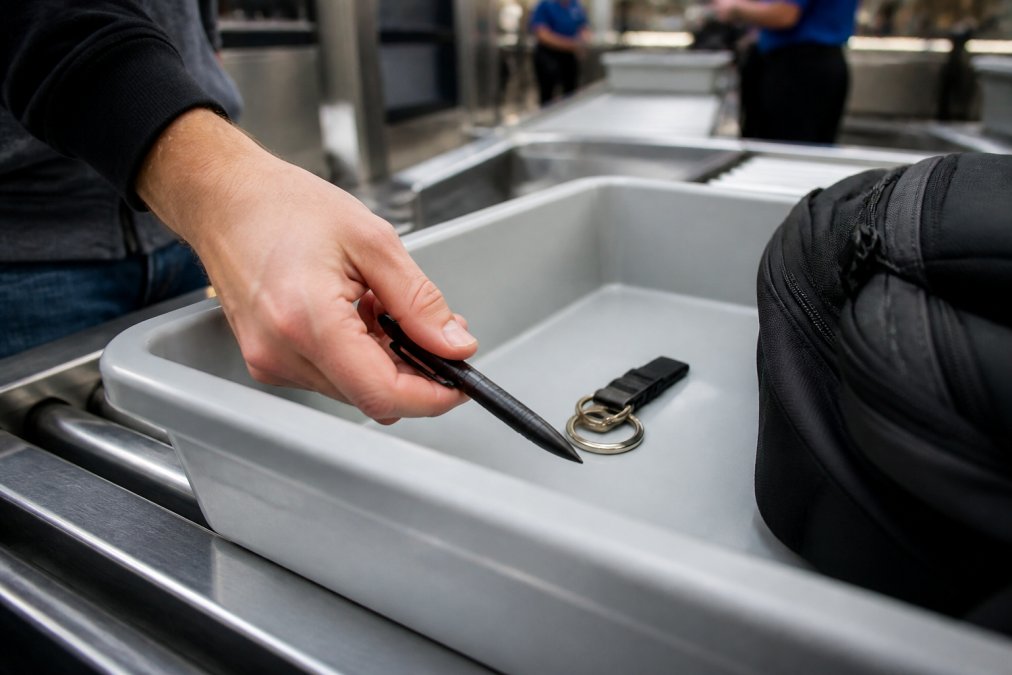
Why TSA Treats Tactical Pens Differently Than Standard Pens
The distinction comes down to a single question: is this item primarily a writing tool or primarily a weapon? Standard ballpoint pens pose zero security risk. Tactical pens sit in a gray zone because they combine the function of a pen with features like a hardened glass breaker tip or a reinforced body that could serve as an impact tool.
TSA officers apply what the agency calls "the reasonable person standard" during screening. If the tactical pen closely resembles a standard pen in size and shape, officers typically allow it through. If the pen features aggressive knurling, an exposed metal spike, or a design that clearly emphasizes its self-defense function over writing ability, an officer may determine it falls under prohibited weapons categories. The TSA's official guidance on what can I bring explains that officers retain discretion when an item appears designed to cause injury.
Aviation security prioritizes preventing items that could threaten aircraft safety. A pen that writes normally, even with a reinforced body, does not threaten that safety. A pen marketed specifically as a weapon with a spike-like tip crosses into a different category entirely.
Understanding the TSA Prohibited Items List
The TSA prohibited items list does not name tactical pens explicitly, which creates confusion for travelers. The list does, however, prohibit "martial arts weapons" and "impact tools" like billy clubs, blackjacks, and brass knuckles. The question becomes whether a specific tactical pen resembles these prohibited categories more than an ordinary writing instrument.
Travelers should review the TSA prohibited items list before packing, paying special attention to how items are described. The list operates on categories rather than specific product names, which is why a tactical pen can be allowed in one situation and flagged in another. Key factors that influence the screening outcome include:
- Tip design: A pointed spike tip reads as a weapon; a rounded glass breaker tip reads as a tool
- Body material: Metal bodies attract more scrutiny than plastic or composite bodies
- Overall appearance: Pens that look aggressive or tactical are more likely to be pulled for inspection
- Branding and marketing: A pen that arrives in packaging touting its self-defense capabilities may raise questions
The travel regulations are designed to keep the sterile area, the secure zone past the security checkpoint, free of items that could be used as weapons. A pen that functions primarily as a pen does not violate this principle.
Checked Baggage Rules for Tactical Gear and Pens
Checked baggage rules for tactical gear are significantly more lenient than carry-on restrictions. If you want to travel with a tactical pen without worrying about checkpoint discretion, place it in your checked bag. The cargo hold does not have the same restrictions because passengers cannot access items stored there during the flight.
Most tactical gear, including tactical pens, multi-tools, and similar self-defense items, travels safely in checked baggage. The main exceptions involve items that are outright illegal, such as certain types of knives with automatic opening mechanisms or weapons banned under federal law. For the vast majority of tactical pens, checked baggage eliminates the uncertainty entirely.
This approach works well for travelers who want to carry their Everyday Carry (EDC) gear to a destination but do not need it during the flight itself. Pack the tactical pen in your checked bag alongside other gear, and you avoid the discretion of the TSA officer entirely. The trade-off is that you lose access to the item if you need it during travel, but for most trips, that trade-off is acceptable.
What Happens If TSA Confiscates Your Pen at the Checkpoint
Having an item pulled aside is a moment of uncertainty, but the process is more structured than most travelers realize. When a TSA officer determines your tactical pen is not permitted past the checkpoint, they will not simply toss it in a bin. You are presented with a clear set of options, and knowing them in advance can save you from losing a valuable piece of gear.
Your Three Options at the Checkpoint
-
Voluntarily Surrender the Item: This is the most straightforward path. You hand the item to the officer, and it is logged and placed in a secured collection bin for disposal. You will not receive compensation, and the item is destroyed according to airport protocol. This is the fastest way to resolve the situation and get on with your journey.
-
Exit Security to Recheck the Item: If you have not yet checked your baggage, you can step out of the security lane, return to the airline ticket counter, and place the pen in a checked bag. This requires you to exit the secure area, which means you will need to go through the entire screening process again. This is a viable option if you have ample time before your flight and your airline's check-in counter is still open.
-
Mail the Item to Yourself or Your Destination: Many major airports have on-site shipping centers or kiosks specifically designed for this scenario. For example, airports like Denver International (DEN) and Phoenix Sky Harbor (PHX) have had services that allow travelers to mail prohibited items. You would leave the security checkpoint, package the pen, and send it to your home address or your hotel. This option costs money for shipping and takes time away from your pre-flight schedule, but it preserves the item.
The Officer's Discretion and the 'Reasonable Person' Standard
The decision to confiscate an item is not arbitrary. TSA officers are trained to apply a 'reasonable person' standard, evaluating whether an item could be used to cause harm to the aircraft or its passengers. A tactical pen with a rounded glass breaker and a standard pen profile is generally viewed as a writing instrument. However, a pen with a sharpened, pointed spike tip or aggressive knurling that clearly signals a self-defense purpose can be classified as an impact weapon.
What About a Fine or a Citation?
For a first-time offense involving a common item like a tactical pen, a fine is unlikely. The primary consequence is confiscation. However, if an officer determines that you intentionally attempted to conceal the item or if the pen is part of a larger collection of prohibited items, you could face a civil penalty. The TSA can levy fines ranging from hundreds to thousands of dollars for knowingly attempting to bring a weapon through a checkpoint. In most cases, a tactical pen that is pulled aside is treated as an honest mistake.
The 'Amnesty' Bin Myth
You may have heard about 'amnesty bins' where travelers can voluntarily dispose of items before the official screening point. These bins are typically located just before the metal detector and are intended for items like pocket knives or small tools that travelers forgot to pack. Placing your tactical pen in an amnesty bin is a form of voluntary surrender. It is a lower-stress alternative to a formal confiscation, but the outcome is the same: you will not get the item back.
Understanding these procedures transforms the experience from a scary unknown into a manageable inconvenience. The best strategy remains prevention, but knowing your options if you are stopped ensures you can handle the situation with confidence and clarity.
Traveling with Self-Defense Keychains: Safer Alternatives
Traveling with self-defense keychains offers a more reliable path through airport security than carrying tactical pens. Keychain tools like kubotans, mini pepper spray dispensers, and personal alarms face different screening considerations. Small keychain accessories that do not resemble weapons typically pass through without issue, while items containing pepper spray face restrictions because of the pressurized contents.
The TSA rules on self-defense items clarify that pepper spray is permitted in checked baggage only under specific conditions regarding container size and safety mechanisms. Carry-on restrictions on pepper spray are strict, so travelers should plan accordingly. Personal alarms and whistles, which make noise to deter attackers, pass through screening without problems because they pose no physical threat.
For travelers who prioritize personal safety, the smartest approach combines a few strategies. Carry a personal alarm on your keychain through security, pack any pepper spray in checked baggage, and choose a tactical pen design that clearly reads as a writing instrument if you must have one in your carry-on. This layered approach ensures you have protection options at your destination without sacrificing peace of mind at the checkpoint.
Smart Travel Tips for Your Tactical Gear
Planning ahead is the single most effective way to ensure your tactical gear arrives at your destination with you. The TSA screening process is designed for speed and security, and items that require a second look create friction. By adopting a few strategic habits, you can minimize that friction and keep your gear safe.
The 'Ship Ahead' Strategy: A Step-by-Step Guide
Instead of risking confiscation at the checkpoint, consider shipping your tactical pen and other dual-use gear to your destination ahead of your flight. This is a common practice among travelers who carry specialized equipment. Here is how to do it effectively:
-
Choose the Right Carrier: USPS Priority Mail Flat Rate boxes are a popular choice for this purpose. They offer predictable pricing and transit times of 2-3 days. UPS and FedEx are also reliable options. For a single pen, a small Flat Rate envelope or box is sufficient and cost-effective.
-
Package Securely: Wrap the pen in bubble wrap or a soft cloth to prevent damage. Place it in a sturdy box with adequate padding. If you are shipping multiple items, ensure they are secured so they do not shift during transit.
-
Address It Correctly: Send the package to your hotel, vacation rental, or the home of a friend or family member you are visiting. Address it to yourself with 'Guest' or 'Hold for Arrival' if sending to a hotel. Call the hotel in advance to confirm they will accept and hold packages for guests.
-
Time Your Shipment: Send the package at least 3-5 business days before your departure to account for any transit delays. This ensures your gear is waiting for you when you land.
-
Insure and Track: For valuable items, add insurance and tracking. This provides peace of mind and a way to locate the package if it is delayed.
This strategy completely removes the TSA officer's discretion from the equation. Your gear is never in your carry-on or checked luggage, so it cannot be confiscated. The trade-off is the cost of shipping and the need to plan ahead, but for many travelers, this is a small price to pay for certainty.
TSA PreCheck: Does It Change the Rules?
TSA PreCheck is an expedited screening program for trusted travelers who have undergone a background check. While PreCheck lanes offer benefits like keeping your shoes and belt on, they do not change the rules for prohibited items. The same restrictions on weapons and impact tools apply. A tactical pen that would be flagged in a standard lane will also be flagged in a PreCheck lane. The difference is that PreCheck travelers are statistically less likely to be randomly selected for a pat-down or a detailed bag search, which reduces the overall scrutiny your gear may face. However, it is not a loophole. You must still comply with the same carry-on rules.
The 'Visual Risk' Self-Assessment
Before you pack, take a hard look at your tactical pen and ask yourself a simple question: 'Does this look more like a writing instrument or a weapon?' This is the same question a TSA officer will ask. A pen with a slim profile, a standard clip, and a discreet glass breaker tip is a low-risk item. A pen with a thick, heavy body, aggressive knurling, and a pointed tip is a high-risk item. If you have any doubt, place it in your checked bag or ship it ahead.
A Final Word on Your EDC Kit
Your everyday carry is a personal system, and it should not be a source of stress when you travel. By separating your gear into 'carry-on safe' and 'check or ship' categories, you can maintain your safety preparedness without compromising your travel experience. The few minutes of planning before you leave home are worth the peace of mind you gain at the airport.
Final Take on Flying with Tactical Pens
| Scenario | TSA Outcome | Best Practice |
|---|---|---|
| Standard tactical pen in carry-on | Generally allowed | Keep design discreet, pen-like |
| Tactical pen with spike tip | Likely confiscated | Pack in checked baggage |
| Tactical pen in checked bag | Allowed | Safest option for travel |
| Self-defense keychain with alarm | Allowed | Carry through checkpoint freely |
| Pepper spray in carry-on | Not permitted | Pack in checked bag only |
The rules around tactical pens and airport security come down to judgment calls by TSA officers. A pen that looks and functions like a pen will almost certainly pass through the security checkpoint. A pen that looks like a weapon may not. The travel regulations prioritize aircraft safety, and officers apply their discretion to items that could threaten that safety.
At Defense Divas Keychains, we design our safety defense keychain sets with travel and daily life in mind, offering stylish accessories that pair with your personal style while serving a practical purpose. Our preorder exclusives give you early access to new designs, and our small business service ensures a personalized shopping experience from order to delivery. When you travel, pack smart, know the rules, and choose gear that works for your lifestyle without adding stress to your journey. Add a Defense Divas Keychains set to your routine and travel with confidence, knowing your safety accessories are both fashionable and functional.
Frequently Asked Questions
Does TSA allow tactical pens in carry-on luggage?
TSA does not have a blanket rule against tactical pens in carry-on bags. Officers have final discretion and may confiscate a pen if it appears to be a weapon. Pens with sharp points, heavy metal bodies, or obvious glass breakers are more likely to draw scrutiny. To reduce risk, pack it in an accessible spot and be prepared to explain its purpose as a writing tool. When in doubt, move it to your checked bag.
Are tactical pens considered weapons by the TSA?
TSA classifies items based on their potential to cause harm. A tactical pen is often treated as a dual-use item, meaning it functions as a writing tool but could serve as an impact tool. The officer's judgment at the checkpoint is the deciding factor. A pen with a pronounced glass breaker tip or one made of solid aircraft-grade aluminum is more likely to be viewed as a self-defense weapon rather than an ordinary pen.
Can I pack a tactical pen in my checked baggage instead?
Yes, checked baggage rules for tactical gear are more lenient than carry-on rules. You can place your tactical pen in a checked bag without issue in most cases. The same applies to self-defense keychains without sharp edges. Since checked bags do not pass through the same passenger screening, the risk of confiscation is much lower. Still, check your airline's policy for any specific restrictions on impact tools.
Will my tactical pen be confiscated by TSA agents?
It depends on the officer's discretion and the pen's design. TSA agents are trained to spot prohibited items, and they may confiscate a tactical pen if they believe it could be used as a weapon. If an item is confiscated, you can either voluntarily surrender it or return it to your car if you have time. Shipping it to your destination is another option, though that costs money for shipping and takes time away from your pre-flight schedule, but it preserves the item.