

Table of Contents
- Blue Luna Alternatives: What You Need to Know
- Quick Comparison of Blue Luna Alternatives
- Personal Safety Alarm vs Pepper Spray: Which Works Better
- Legal Self-Defense Tools for Women: What's Allowed Where You Live
- How to Use a Safety Keychain Effectively
- Choosing the Right Safety Tool for Your Lifestyle
- Conclusion
Last Updated: August 11, 2026
Blue Luna Alternatives: What You Need to Know
Personal safety doesn't have to mean carrying something that screams "self-defense tool." If you're exploring blue luna alternatives for safety, you're likely looking for something discreet, effective, and maybe a little more stylish than what's out there. The market for personal safety accessories has exploded in recent years, and the options now range from compact alarms to GPS trackers to keychain devices that actually look like something you'd want to carry.
At Defense Divas Keychains, we understand that safety is personal. What works for your commute might not work for your weekend travels. That's why we've compiled this guide to help you navigate the landscape of blue luna alternatives, comparing real tools, understanding what actually works, and showing you how to choose based on your specific lifestyle and risk profile.
The goal here isn't to scare you into buying everything. It's to give you clarity on what each tool does, where it falls short, and which option makes sense for your actual situation. Let's start with a quick overview of how these alternatives stack up.
Quick Comparison of Blue Luna Alternatives
When you're evaluating blue luna alternatives for safety, you're really asking three questions: Does it work? Can I carry it discreetly? And will it actually help me in a real emergency?
| Tool | Best For | Key Feature | Activation |
|---|---|---|---|
| Defense Divas Keychains | Style-conscious users seeking trendy designs | Unique Western-inspired designs with preorder access | Manual pull or press |
| Silent Beacon Personal Safety Alarm | Discreet portability with app connectivity | 135 dB siren + LED light + Bluetooth app alerts | Button press or app trigger |
| Noonlight | Silent SOS to emergency dispatch | Direct 911 connection without speaking | Hold-and-release button |
| bSafe | Real-time GPS tracking with contacts | Live video streaming + voice activation | SOS button or voice command |
| Care Go GPS Tracker | Continuous tracking without recurring fees | Silent GPS alerts to unlimited contacts, no monthly fees | App-based SOS or button |
| SABRE Pepper Spray | Immediate physical deterrent | Maximum strength formula with 10-foot range | Quick-release keychain |
| Thopeb Personal Safety Alarm | Non-confrontational alert | 130+ dB siren with simple pull-pin activation | Pull pin mechanism |
| MiniFinder Nano | Seniors or high-risk situations | GPS + fall detection + two-way communication | SOS button |
| Life360 | Family coordination and monitoring | Real-time location sharing + crash detection | App-based SOS or automatic alerts |
| Swann ActiveResponse | GPS alerts without subscription fees | 110 dB siren + free SMS alerts with location | Ring pull mechanism |
The table above shows the landscape, but here's what matters: each tool solves a different problem. A personal alarm works if someone is close enough to hear it. Pepper spray requires you to be willing to use it in the moment. GPS trackers only help if someone is actively monitoring and can respond. There's no single "best" option, only the best option for your situation.
Personal Safety Alarm vs Pepper Spray: Which Works Better
This is the question that comes up most often when people are exploring blue luna alternatives: Should I go with something that makes noise or something that creates a physical barrier?
The honest answer is that they solve different problems. A personal safety alarm works by creating noise and drawing attention. Pepper spray works by incapacitating a threat at close range. One is about deterrence and escape. The other is about stopping an immediate physical threat.
Personal alarms like the Silent Beacon or Thopeb operate on a simple principle: make enough noise that an attacker loses interest and bystanders pay attention. A 130-135 dB siren is genuinely loud, comparable to a fire alarm or power drill. The psychological effect matters here. Most attackers want an easy target, not a situation that's suddenly drawing public attention. The alarm also provides a moment to escape, which is your actual goal in most scenarios.
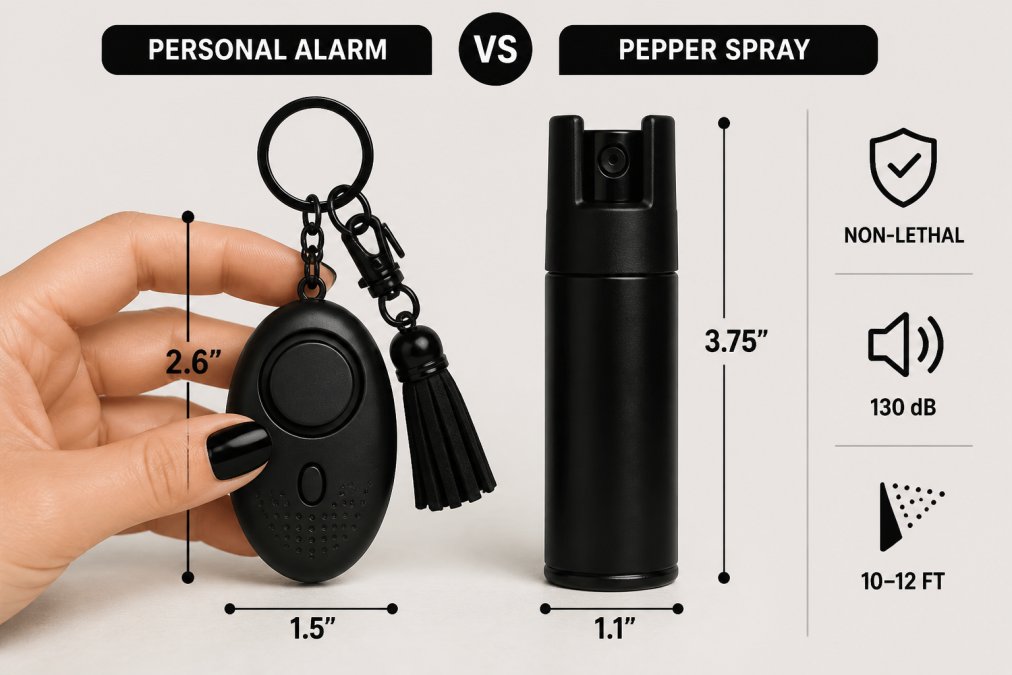
Pepper spray, represented well by SABRE's quick-release keychain, works differently. It creates an immediate physical effect, temporary blindness, respiratory irritation, skin burning. If someone is already in close contact with you, an alarm won't help much. Pepper spray might. The range matters too. SABRE's spray reaches up to 10 feet, giving you distance from the threat.
The catch with pepper spray: you need to be willing to deploy it in the moment, and you need to deploy it correctly. Wind direction affects effectiveness. Adrenaline can make aim difficult. You also need to know it's legal where you live, some states restrict it, others require permits, and some have restrictions on strength or canister size.
A common mistake is assuming one tool is "better" than the other. They're complementary. An alarm is excellent for preventing an encounter from escalating. Pepper spray is better if prevention fails. Many people carry both.
Legal Self-Defense Tools for Women: What's Allowed Where You Live
This is the part most guides skip, and it's the part that actually matters. A tool that's illegal where you live isn't a safety tool, it's a liability.
Legal self-defense tools for women vary significantly by state and sometimes by city. What's legal in one state might be a felony in another. Pepper spray is legal in all 50 states, but many states cap the strength (usually measured in Scoville Heat Units) and canister size. Some states require you to be 18 or older. A few states require permits.
Personal alarms are legal everywhere in the United States. There's no regulation around noise-making devices for self-defense purposes. This is a significant advantage if you're traveling between states or moving soon.
GPS trackers and safety apps like Noonlight, bSafe, and Life360 are legal everywhere. They're communication tools, not weapons. No restrictions.
Keychain-based tools like those offered by Defense Divas Keychains operate in the legal gray area, they're designed as accessories first, safety tools second. The styling matters here. A keychain that looks like fashion is treated differently legally than one that looks tactical. This is why many people prefer stylish alternatives: they function as personal safety tools without the legal ambiguity.
Before you buy any tool, check your state's laws. Most states have straightforward regulations published online. If you're moving or traveling, check the destination state too. A tool that works perfectly in your home state might be confiscated at airport security or illegal where you're visiting.
How to Use a Safety Keychain Effectively
Carrying a safety tool and knowing how to use it are two completely different things. A tool you don't practice with won't help you in a real moment.
How to use a safety keychain effectively depends on the specific tool, but the principles are the same. First, accessibility. Your keychain should be on your person at all times, not in a bag you might not have quick access to. Attach it to your keys, your bag's front pocket, or your belt loop. The moment you need it, you won't have time to dig.
Second, familiarity. If it's a pull-pin alarm, practice pulling the pin a few times so your hands know the motion. If it's a button-based alert, know exactly where the button is and how much pressure it requires. If it's pepper spray, understand the spray pattern, stream or fog, and practice aiming (without actually spraying) so you know the mechanics.
Third, intention. Decide in advance when you'd actually use it. Not in a vague "if something bad happens" way, but specifically. For example: "I'll use my alarm if someone follows me off the bus." Or "I'll deploy pepper spray if someone grabs me and won't let go." Having a mental trigger helps you act faster when adrenaline is high.
Most personal safety tools require you to be conscious and capable of activating them. That's their limitation. They're not passive protection. They're active tools that depend on you recognizing a threat and responding. This is why situational awareness matters more than the tool itself. The best safety tool is the one that prevents you from being in a dangerous situation in the first place.
Choosing the Right Safety Tool for Your Lifestyle
This is where the decision gets personal. The "best" blue luna alternative for safety depends entirely on how you actually live.
If you commute on public transit or walk in urban areas, a personal alarm or compact GPS tracker makes sense. You want something that creates attention without requiring you to be in close contact with a threat. The Silent Beacon or Thopeb alarm fits this profile, small, discreet, effective in crowded environments.

If you travel frequently, consider a GPS tracker like Care Go or a safety app like Noonlight. These work across different locations without legal ambiguity. They're also useful if you're traveling with family who might want to track your location.
If you're in situations where you might be in close physical contact with a threat, working late-night shifts, traveling to unfamiliar areas alone, or dealing with a specific safety concern, pepper spray becomes more relevant. SABRE's quick-release keychain is compact and accessible. But again, know your state's laws first.
If you care about aesthetics and want a tool that doesn't scream "self-defense," Defense Divas Keychains offers stylish options that function as personal safety tools. The Western-inspired designs and preorder exclusives mean you're not carrying something that looks purely tactical. Many people feel more confident carrying something that matches their style.
If you want something that requires no activation, no button to press, no pin to pull, no app to open, Life360 or a similar location-sharing app works passively. Family members can see where you are without you doing anything. The trade-off is that it requires someone to actively monitor and respond.
The right choice depends on your actual risk profile, your lifestyle, and your comfort level with different tools. A college student in a dense urban area has different needs than someone commuting through quieter suburbs. A frequent traveler has different needs than someone with a stable routine.
Conclusion
The blue luna alternatives for safety landscape has matured significantly. You're no longer choosing between one or two options, you're choosing from tools designed for different situations, different comfort levels, and different aesthetics.
Defense Divas Keychains stands out because we understand that safety is personal. Our stylish, Western-inspired keychain designs let you carry protection that matches your aesthetic. With preorder exclusives and personalized service, you get early access to new items and the attentive care only a small business can provide. Whether you're looking for something trendy or something practical, our unique designs ensure you're not compromising on either.
Frequently Asked Questions
Are self-defense keychains legal in all states?
No. Self-defense keychain legality varies significantly by state and even by city. Some states restrict pepper spray keychains, while others prohibit certain impact tools. Personal safety alarms and GPS trackers are generally legal nationwide, but it's essential to check your state's specific laws before purchasing. Contact your local law enforcement or review your state's self-defense laws to confirm what's permitted where you live.
What's the difference between a personal safety alarm and pepper spray?
A personal safety alarm emits a loud siren (typically 110-135 dB) to disorient attackers and attract attention from nearby people. Pepper spray is a chemical irritant that incapacitates an attacker temporarily. Alarms require others to hear and respond; pepper spray works at distance (up to 10 feet) but can be affected by wind. Alarms work in any weather, while pepper spray effectiveness varies. Choose based on your comfort level with confrontation and local legality.
How do I use a safety keychain effectively in an emergency?
Keep your safety keychain easily accessible on your keyring or bag, not buried at the bottom. Practice pulling or activating it before you need it so muscle memory takes over under stress. For alarm keychains, pull the pin decisively and hold it toward potential threats. For pepper spray, aim slightly downward in a short burst and move away immediately. For GPS trackers, activate the SOS button and move to safety. Regular practice builds confidence and faster response time.
What makes Blue Luna alternatives different in terms of actual protection?
Blue Luna alternatives vary in approach: keychain alarms rely on sound deterrence and bystander help, while pepper spray offers direct chemical defense at distance. GPS trackers and safety apps provide location sharing and emergency contact alerts rather than physical deterrence. Some tools like Care Go combine GPS tracking with silent alerts to contacts. Effectiveness depends on your situation, a loud alarm works well in public spaces; pepper spray offers more control in isolated areas. The best choice combines your comfort level, local laws, and daily routine.
Do I need a subscription for personal safety devices?
It depends on the tool. Basic personal alarm keychains are one-time purchases with no recurring fees. GPS trackers like Care Go also work as one-time purchases without monthly costs. Safety apps like Noonlight and bSafe offer free basic features with optional paid subscriptions for advanced capabilities. Life360 charges $14.99-$24.99 monthly for premium features. Evaluate whether you need real-time GPS tracking or just an emergency alert button to decide if a subscription-based tool makes sense for your budget.
The right tool is the one you'll actually carry and use. That means it needs to fit your lifestyle, your budget, and your comfort level. Start by assessing your actual risk profile. Then match it to a tool that solves that specific problem. And remember: the tool is the backup plan. Situational awareness, trusted contacts, and a clear head are your primary defenses. Add the right safety tool to that foundation, and you've got a solid personal safety strategy.