

Table of Contents
- Hootie vs Birdie: Quick Comparison Table
- How Personal Safety Alarms Work and Why They Matter
- Best Personal Safety Alarm for Women: Activation and Ease of Use
- Decibel Levels, Sound Intensity, and Real-World Effectiveness
- Battery Life, Maintenance, and Testing Protocols
- TSA Regulations for Personal Alarms and Travel Security
- Self Defense Kit Essentials: Pairing Your Alarm with Other Tools
- Hootie vs Birdie: Which One Should You Choose?
Last Updated: August 27, 2026
Hootie vs Birdie: Quick Comparison Table
When choosing a personal safety alarm, the decision between Hootie and Birdie comes down to what features matter most to you. Both devices deliver the core functionality you need: a loud siren, strobe light, and keychain portability. But their activation mechanisms, battery systems, and design philosophies differ in ways that affect real-world reliability and ease of use.
| Feature | Hootie | Birdie (Original) | Birdie+ |
|---|---|---|---|
| Siren Volume | 130 decibels | 130 decibels | 130 decibels |
| Activation | Pull-pin | Pull-pin | Pull-pin + App |
| Battery Type | Non-replaceable (1 year rated) | Replaceable | Rechargeable |
| Runtime | 30-40 minutes continuous | Varies by battery | Rechargeable battery |
| Strobe Light | LED | Flashing | Flashing |
| App Features | None | None | Location sharing, excuse call, live support |
| Design Focus | Simplicity | Aesthetics | Smart features |
| Best For | Straightforward users | Fashion-conscious users | Maximum safety features |
The table reveals what matters most: if you want simplicity and reliability, Hootie's straightforward design wins. If aesthetics matter and you want flexibility with replaceable batteries, the original Birdie delivers. If you need smart features and don't mind a subscription, Birdie+ adds layers of protection beyond the alarm itself.
How Personal Safety Alarms Work and Why They Matter
A personal safety alarm is a compact, battery-operated device that emits an extremely loud siren and often includes a strobe light to attract attention and deter potential threats. When activated, it creates an auditory and visual deterrent designed to startle an attacker, alert nearby people, and prompt emergency response.
The mechanism is straightforward: a small speaker powered by a battery connects to a simple activation mechanism. When you pull the pin, it completes a circuit that triggers the siren and strobe light simultaneously.
Personal safety alarms offer several advantages over other self-defense tools. They're non-lethal, legal in all states (with TSA air travel restrictions), and require no training or physical strength to use effectively (tsa.gov). Unlike pepper spray or tasers, they don't require contact with a threat. They work purely through deterrence: the noise and light startle an attacker and alert others to your situation.
A 130-decibel alarm is as loud as a jet engine at takeoff (the CDC). Combined with a strobe light, it creates sensory overload that gives you time to escape. Personal safety alarms fit into a broader self-defense strategy as one tool in a toolkit that includes situational awareness, communication devices, and sometimes additional self-defense items. For college students, solo commuters, and travelers, they're particularly valuable because they're discreet, legal everywhere (with TSA exceptions), and effective when you need them most.
Best Personal Safety Alarm for Women: Activation and Ease of Use
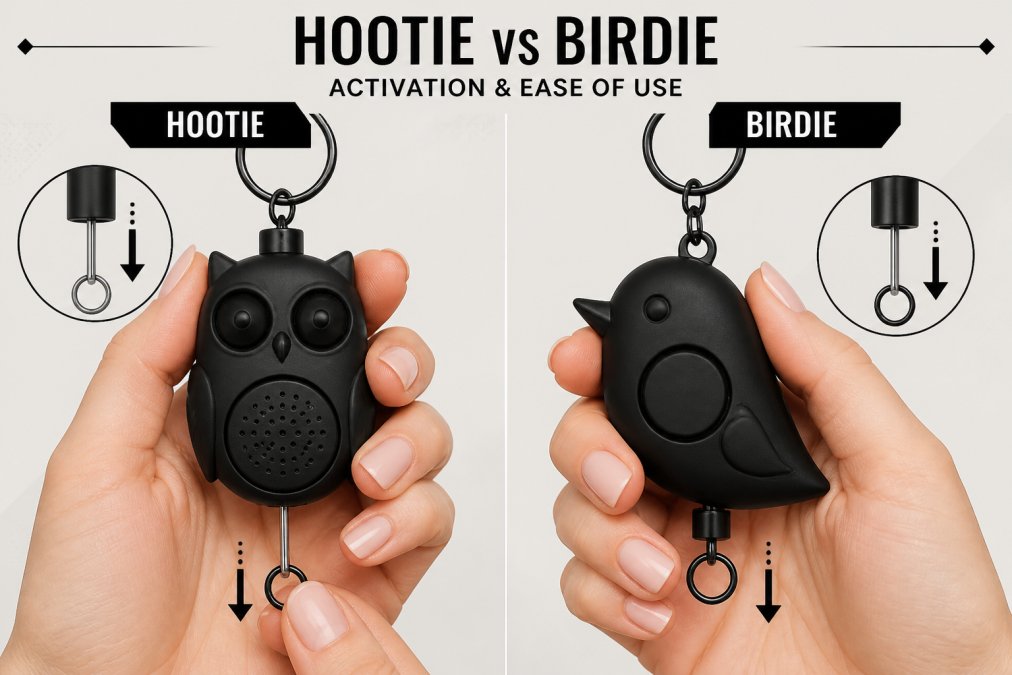
The difference between Hootie and Birdie becomes immediately apparent when you hold them. Hootie prioritizes simplicity; Birdie prioritizes aesthetics. Both use the same activation method: a pull-pin mechanism that's faster and more reliable than button-based alarms.
Pull-Pin vs Button Activation
Pull-pin activation has a clear advantage over button-based systems: it's nearly impossible to trigger accidentally, yet it's faster to deploy in an emergency. When you pull the pin, the siren starts immediately. There's no fumbling, no button to locate, no risk of pressing it twice or holding it too long.
Button-based alarms require you to find and press a small button in a moment of panic. Some users report accidental activations when the button gets pressed in a bag or pocket. Others find that in high-stress situations, their fine motor control fails and they can't locate the button quickly enough.
Both Hootie and Birdie use pull-pin activation, so they're equal on this front. The real difference is the keychain design. Hootie's is utilitarian with a clearly visible pin. Birdie comes in multiple colors and aesthetic styles, designed to look like a fashion accessory rather than a safety device. Hootie wins on instant recognition; Birdie wins if you want it to blend with your other accessories.
False Alarm Prevention
False alarms are a real concern with personal safety alarms. Pull-pin activation won't activate from pressure or impact alone, the pin must be deliberately pulled. However, some users report that Hootie's pull mechanism can be sensitive if the device gets squeezed hard enough, while Birdie's design feels more robust when packed in a bag.
To prevent false alarms with either device, keep the pin firmly seated and store the alarm in a dedicated pocket or pouch where it won't get compressed. Testing your alarm regularly also helps you understand how much force is actually needed to activate it.
Decibel Levels, Sound Intensity, and Real-World Effectiveness
Both Hootie and Birdie produce a 130-decibel siren. To understand what that means: 120 decibels is a jet engine at takeoff, 110 is a rock concert, 100 is a chainsaw. At 130 decibels, these alarms are legitimately loud, loud enough to cause temporary hearing damage if you're standing right next to them during activation.
A 130-decibel alarm will be heard from several hundred feet away in most environments. In an urban setting, it cuts through traffic noise. In a quiet residential area, it will wake neighbors in nearby houses. The strobe light adds a visual component that's especially valuable in low-light conditions or when the sound alone might be dismissed as a car alarm.
Real-world effectiveness depends on context. An alarm is most effective when there are people nearby who can respond to the noise. In a crowded area, the siren attracts attention and potential help. On an empty street late at night, the alarm still startles the threat and gives you time to escape, but there may be no one to call police or intervene.
The sound pressure level of 130 decibels is consistent across both devices, so neither has an acoustic advantage. The difference in real-world effectiveness comes down to how quickly you can activate the alarm and how your environment responds to the noise.
Battery Life, Maintenance, and Testing Protocols
Battery reliability is where Hootie and Birdie diverge significantly. Hootie uses a non-replaceable battery rated for one year of shelf life. Birdie (original) uses replaceable batteries, giving you flexibility to swap them out as needed. Birdie+ uses a rechargeable battery, eliminating the need for replacements but requiring you to remember to charge it.
The one-year rating on Hootie's battery assumes normal shelf storage. If you activate the alarm even once, the battery drains significantly. For testing purposes, this is a consideration. Birdie's replaceable batteries mean you can test without worrying about draining your only power source.
Comparative Battery Testing
Testing your alarm quarterly is essential. You need to know it actually works before you need it in an emergency. Pull the pin for 2-3 seconds in an outdoor location where the noise won't startle others. You'll hear the siren and see the strobe light activate.
With Hootie, this quarterly test gradually depletes your one-year battery. After several tests, you may find yourself approaching that one-year expiration with a partially depleted battery. This is a design flaw: a device meant for emergency use shouldn't lose reliability just because you tested it responsibly.
With Birdie (original), you can test freely because you can replace the battery afterward. With Birdie+, testing is consequence-free because you can recharge it.
If you carry a personal safety alarm, you will test it. Choose a device that won't penalize you for doing so.
Regular Testing and Maintenance
Beyond battery testing, maintenance is minimal. Keep the device dry and avoid extreme temperatures. Store it in a cool, dry place, not in a hot car or damp gym bag. Once per quarter, verify the pin is secure and do a brief activation test.
For Birdie devices, check that the battery contacts are clean. For Birdie+, verify that the app still connects and that your emergency contacts are current. For Hootie, note the purchase date and plan to replace the device before the one-year mark if you've done any testing.
TSA Regulations for Personal Alarms and Travel Security
Personal safety alarms are legal to own and carry in all states. However, the Transportation Security Administration has specific rules for air travel. According to TSA guidelines on prohibited items, personal alarms with self-defense features are generally allowed in checked baggage but not in carry-on luggage.
TSA officers have discretion, and enforcement varies by airport and officer. The safest approach is to pack your alarm in checked luggage if you're flying.
If you're traveling by car, train, or bus, personal alarms face no restrictions. They're legal to carry on your person or in your bag. This makes them particularly valuable for road trips, college commutes, and travel to unfamiliar cities.
For international travel, check the regulations of your destination country. Some nations have restrictions on personal alarms or require specific certifications.
The TSA distinction matters because it affects how you carry your alarm during travel. If you're a frequent flyer, this limitation might push you toward Birdie+ because the app features provide some security benefit even if the physical alarm is in checked baggage.
Self Defense Kit Essentials: Pairing Your Alarm with Other Tools
A personal safety alarm is most effective as part of a broader self-defense strategy. Here's what safety-conscious brands recommend pairing with your alarm:
Keychain design and accessibility. Your alarm needs to be immediately accessible on the same keychain as your house key or car key, not buried in your bag. A stylish, functional design makes you more likely to keep it accessible.
Communication device. A fully charged phone is essential. Your alarm gets attention; your phone gets help. Make sure emergency contacts are programmed and your phone is accessible.
Situational awareness. Being aware of your surroundings, trusting your instincts, and avoiding high-risk situations prevents most threats before they escalate.
Additional self-defense items. Depending on your location and comfort level, you might add pepper spray, a personal safety whistle, or a self-defense keychain.
Lighting. A small flashlight on your keychain helps you see potential threats and makes you more visible to others.
Your personal safety alarm is most effective when it's part of a coordinated approach. You're not relying on the alarm alone; you're using it as one component of a comprehensive safety strategy.
Hootie vs Birdie: Which One Should You Choose?
The answer depends on what matters most to you: simplicity, aesthetics, smart features, or battery flexibility.
Choose Hootie if: You want straightforward, no-frills protection. You value simplicity over features. You don't plan to test your alarm frequently and you're comfortable with a one-year battery lifespan. You want the most compact, utilitarian design.
Choose Birdie (original) if: You want flexibility with replaceable batteries so you can test without depleting your device. You prefer a design that looks like a fashion accessory rather than a safety tool. You want multiple color options to match your style. You value the balance between affordability and functionality.
Choose Birdie+ if: You want the most comprehensive safety features available. You're comfortable with an annual subscription for app-based features like location sharing and live support access. You want a rechargeable battery that eliminates the need for replacements. You value the "excuse call" feature for getting out of uncomfortable situations.
Hootie and Birdie (original) are nearly equivalent devices with different design philosophies. The 130-decibel siren and strobe light are identical. The pull-pin activation is the same. The main difference is that Birdie offers replaceable batteries and aesthetic variety, while Hootie prioritizes simplicity and lower cost.
Birdie+ is a different category entirely. It's not just an alarm; it's a comprehensive safety system. If you're willing to pay for the subscription and use the app features, it's worth the investment. If you just want an alarm on your keychain, the original Birdie or Hootie will serve you just as well.
The best personal safety alarm is the one you carry consistently, keep accessible, and maintain properly. All three options deliver on the core functionality. Your decision should reflect how you live, what features matter to you, and which design you're most likely to keep on your keychain every single day.
Frequently Asked Questions
How do personal safety alarms actually work, and will they stop someone in a real emergency?
Personal safety alarms emit a loud siren (typically 130 decibels) and often include a strobe light to attract attention and create an auditory deterrent. They don't physically stop an attacker but work by drawing attention from bystanders and potentially causing the threat to flee. The effectiveness depends on your surroundings, they work best in populated areas where people can hear and respond. Think of them as a non-lethal defense tool that increases your chances of getting help, not a guaranteed protection device.
Can you bring a Hootie or Birdie personal safety alarm through TSA security?
TSA regulations for personal alarms vary by device. Pull-pin activated alarms like Hootie and the original Birdie are typically allowed in carry-on and checked baggage because they don't contain explosive material. However, the TSA website recommends contacting your airline before traveling, as individual airlines may have different rules. If you're uncertain, pack it in checked baggage to avoid delays. Always verify current TSA regulations before your trip, as policies can change.
What's the difference between Hootie and Birdie in terms of battery life and maintenance?
Hootie features a battery rated for one year and runs continuously for 30-40 minutes when activated. The original Birdie uses replaceable batteries, while Birdie+ is rechargeable. Both require periodic testing to ensure they work when needed. Test your alarm monthly by pressing the activation mechanism briefly in a safe location to confirm the siren and light function. Replace batteries annually or when you notice reduced volume, and store your alarm in a cool, dry place to maximize battery longevity.
Which personal safety alarm is better for women commuters and college students?
For the best personal safety alarm for women, choose based on your lifestyle. Hootie offers simplicity and reliability with its straightforward pull-pin design and one-year battery. The original Birdie provides similar core features with more color options if aesthetics matter to you. Birdie+ adds app-based features like location sharing and live support, which appeal to those wanting extra layers of protection. College students and commuters benefit most from whichever design you'll actually carry consistently, that accessibility matters more than advanced features.
Choosing between personal safety devices shouldn't mean compromising on style or reliability. At Defense Divas Keychains, we believe your safety accessories should reflect your personality while delivering real protection. Explore our collection of stylish safety keychains and Western-inspired designs that combine function with fashion. Get started with Defense Divas Keychains and carry confidence with every step.