

Table of Contents
- Understanding Self-Defense Tool Laws by State
- Best Non-Lethal Self-Defense Tools for Everyday Carry
- Is Pepper Spray Legal in All States?
- Can You Take Safety Keychains on Airplanes?
- Essential Training and De-Escalation
- Legal Liability and Responsible Carry
- Choosing the Right Tool for Your Lifestyle
- Conclusion
Last Updated: August 30, 2026
Understanding Self-Defense Tool Laws by State
Carrying self-defense tools legally requires understanding both federal regulations and the specific state laws where you live or travel. What's perfectly legal in one state may be prohibited in another. State laws govern everything from pepper spray concentration levels to stun gun possession and blade length restrictions, while federal law restricts what you can carry on airplanes or across state lines.
Best Non-Lethal Self-Defense Tools for Everyday Carry
Non-lethal self-defense tools offer effective protection without lethal force. These items are designed to incapacitate, deter, or draw attention to a threat, giving you time to escape.
Pepper Spray and OC Gel Options
Pepper spray and OC (oleoresin capsicum) gel are among the most popular non-lethal self-defense tools. They work by causing temporary incapacitation, burning eyes, throat swelling, and disorientation, that allows you to escape. Gel formulations offer advantages over traditional spray in windy conditions, as they're less likely to blow back toward you.
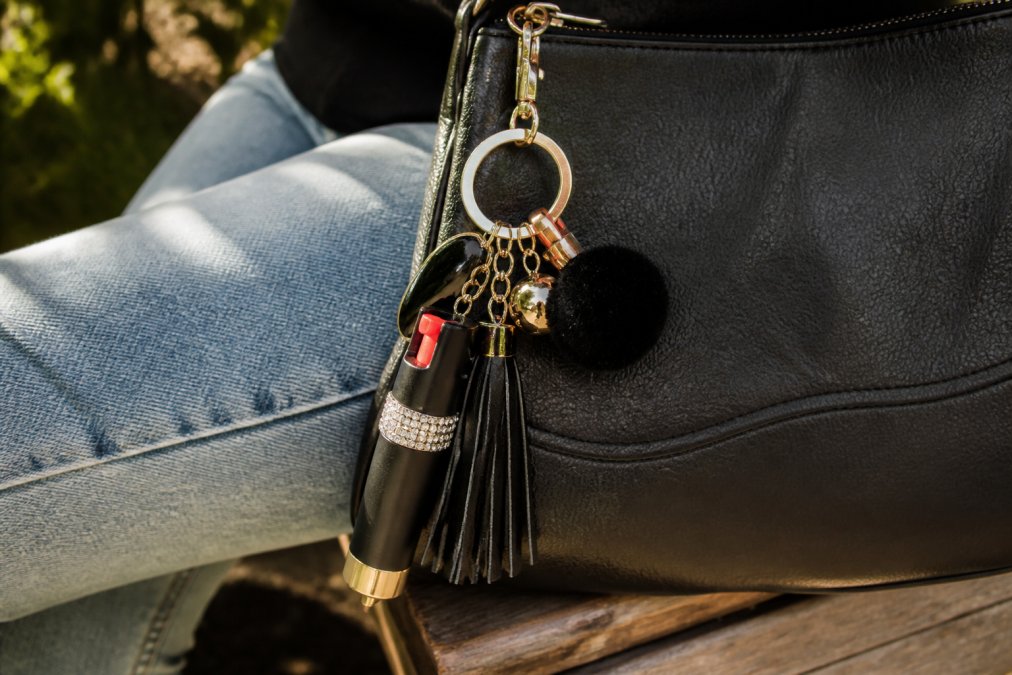
Defense Divas Keychains offers stylish pepper gel options that combine personal defense with a discreet keychain design. The gel formulation can reduce blowback, and UV dye can help identify attackers. This type of tool is legal in all 50 states, though state-specific restrictions on concentration levels, canister size, and age requirements vary. Some states limit OC concentration to 2-5%, while others allow up to 18%.
The major limitation is air travel, pepper spray cannot be carried in carry-on luggage on commercial flights. Additionally, some states require you to be 18 or older to purchase pepper spray.
Striking Tools and Keychain Designs
Striking tools enhance your ability to defend yourself through impact. These range from traditional kubotans to modern keychain designs that double as effective striking implements. Striking tools are legal in all 50 states when designed and used for self-defense purposes.
The Original Blunted Kubotan Keychain is a cylindrical self-defense tool typically 5-6 inches long, designed to amplify striking power and apply pressure to sensitive points. Defense Divas Keychains offers stylish striking keychains, such as those with a cat-shaped design with pointed ear tips for close-range defense, constructed from durable materials with a dual finger hole design.
One important caveat: some states classify cat-shaped keychains as "brass knuckles," which are illegal in states like California and New York. Before purchasing, verify that your state's definition of prohibited weapons doesn't include your chosen striking tool.
Personal Alarms and Multi-Tool Devices
Personal alarms emit a loud siren, typically 120-140 decibels, to deter attackers and draw attention from bystanders (peer-reviewed research). They're legal in all 50 states and TSA-compliant for carry-on luggage, making them ideal for travel. Unlike pepper spray or stun devices, they require no training and pose no risk of accidental injury to yourself.
The Mace Brand Personal Alarm is available in pull-pin or button-activated models. At 120-140 decibels, it produces a sound equivalent to a jet engine at close range, designed to startle attackers and alert people nearby to your emergency.
Combination devices like the Safely Sidekick integrate multiple tools, pepper spray, a 130 dB personal alarm, and a built-in flashlight, into a single compact unit. However, the pepper spray component cannot be carried on airplanes, limiting the device's usefulness for frequent travelers.
Is Pepper Spray Legal in All States?
Pepper spray is legal in all 50 states, but restrictions vary significantly by jurisdiction. Some states limit the concentration of OC (oleoresin capsicum), the active ingredient. Others restrict canister size, age of purchase, or require specific labeling.
Federal law does not prohibit pepper spray, but individual states have created their own rules. For example, New York restricts OC concentration to 2% and limits canister size to 0.75 ounces. California allows higher concentrations but restricts sales to people 18 and older. Some states require that pepper spray be manufactured with a UV dye for identification purposes.
The most important restriction across all states is air travel. According to the Transportation Security Administration guidelines, one 2% by mass OC tear gas self-defense spray is permitted in checked baggage only if it is equipped with a safety mechanism to prevent accidental discharge. Pepper spray is absolutely prohibited in carry-on luggage on any commercial flight.
Before traveling with pepper spray, check both your destination state's laws and your airline's specific policy.
Can You Take Safety Keychains on Airplanes?
TSA rules on self-defense keychains depend on what the keychain contains and how it functions. Personal alarms, striking tools, and some multi-tool keychains are TSA-compliant for carry-on luggage. Pepper spray, stun guns, and tactical pens are prohibited in carry-on and checked baggage.
Allowed in carry-on luggage:
- Personal alarms (no restrictions)
- Striking tools like kubotans and cat keychains
- Key-shaped self-defense tools like the Peace KEYper
- Multi-tool devices without pepper spray or stun capability
Prohibited in carry-on and checked baggage:
- Pepper spray and OC gel
- Stun guns and tasers
- Tactical pens designed for striking
- Multi-tool devices containing pepper spray
The TSA's prohibited items list specifies that self-defense sprays are only allowed in checked baggage under specific conditions. Stun devices are prohibited entirely.
If you're a frequent traveler, personal alarms and striking keychains offer the best compliance. Defense Divas Keychains offers striking tools and alarm-based options that work well for people who travel regularly.
Essential Training and De-Escalation
Carrying a self-defense tool is only effective if you understand how to use it and, more importantly, when to use it. Training and situational awareness prevent most dangerous situations before they escalate.
De-escalation, the practice of reducing tension in a threatening situation, should be your first priority. Most confrontations can be avoided or resolved without physical force. De-escalation techniques include maintaining calm body language, using a steady voice, creating distance between yourself and the threat, and looking for escape routes.
Situational awareness complements de-escalation. This means paying attention to your surroundings, noticing people who seem focused on you, and recognizing environmental cues that suggest danger. Awareness allows you to avoid threats entirely.
Self-defense tool training teaches you how to deploy your chosen tool quickly and effectively. Many people purchase pepper spray or stun devices but never practice using them. In a real emergency, muscle memory and confidence matter.

Legal Liability and Responsible Carry
Using any self-defense tool carries legal responsibility. Self-defense laws vary by state, but most jurisdictions recognize your right to use reasonable force to protect yourself from imminent harm. The key word is "reasonable", the force you use must match the threat level.
Using a self-defense tool when you're not facing imminent danger, or using excessive force against a minor threat, can result in criminal charges. Most states follow a "duty to retreat" or "stand your ground" framework. In duty-to-retreat states, you're expected to leave the situation if you safely can before using force. In stand-your-ground states, you have no obligation to retreat before defending yourself.
Liability insurance exists for self-defense tool use. Specialized self-defense liability insurance is available through organizations focused on personal protection and covers legal defense costs if you're charged with a crime or sued civilly after using a self-defense tool.
If you use a self-defense tool, contact police immediately and provide a clear account of events. Injuries or damage should be documented, and witness statements strengthen your legal position.
Choosing the Right Tool for Your Lifestyle
The best self-defense tool matches your lifestyle, legal environment, and comfort level.
For frequent travelers: Personal alarms and striking keychains are your best options. They pass airport security and work in all states.
For urban commuters: Pepper spray or OC gel provides strong incapacitation if you're not flying. Combine it with a personal alarm for layered protection.
For fashion-conscious users: Defense Divas Keychains specializes in stylish self-defense tools that coordinate with your aesthetic. Western-inspired designs, rhinestone embellishments, and color options let you choose protection that matches your personal style.
For people seeking simplicity: A single, multi-purpose tool reduces decision fatigue. The Safely Sidekick combines pepper spray, alarm, and flashlight.
Consider your comfort with different tool types. Your psychological comfort with a tool directly affects whether you'll carry it consistently and use it effectively if needed.
Conclusion
Carrying self-defense tools legally means understanding your state's specific laws, choosing tools that match your lifestyle, and committing to training and responsible use. Whichever tool you choose, verify its legality in your jurisdiction, learn how to use it effectively, and prioritize de-escalation and situational awareness as your first line of defense.
Defense Divas Keychains offers stylish, effective self-defense options designed for everyday carry. From striking keychains to pepper gel formulations, our Western-inspired designs let you protect yourself without sacrificing your personal style. Explore our preorder exclusives for early access to trending self-defense accessories, and get started with a tool that matches your lifestyle and keeps you confident in any situation.
Frequently Asked Questions
What self-defense tools can I legally carry every day?
Personal alarms, tactical flashlights, and kubotan keychains are legal in all 50 states for everyday carry. Pepper spray is legal in most states but has concentration and size restrictions that vary by location. Stun guns are prohibited in some states like Michigan and Rhode Island. Always check your specific state's statutes before carrying any self-defense tool, as laws change and local ordinances may impose additional restrictions on what you can lawfully possess.
Can you take safety keychains on airplanes?
TSA rules depend on the tool type. Personal alarms and non-weaponized striking keychains are TSA-approved for carry-on luggage. Pepper spray, stun guns, and tactical pens are prohibited in both carry-on and checked baggage. Kubotan keychains and cat-shaped keychains may also be subject to restrictions as carry-on items. If you travel frequently with self-defense tools, choose TSA-compliant options or pack restricted items in checked luggage when permitted by your airline and destination state.
Is pepper spray legal in all states?
Pepper spray is legal in most states but not all. Some states restrict the concentration of OC (oleoresin capsicum), the canister size, or the age at which you can carry it. A few states prohibit civilian use entirely. Concentration limits typically range from 2% to 5.3% OC, though some states allow higher strengths. Before purchasing or carrying pepper spray, verify your state's specific requirements on concentration, canister volume, and any permit or training requirements that may apply.
Do I need training to carry self-defense tools legally?
Most self-defense tools don't legally require training, but practical training is strongly recommended. Personal alarms and tactical flashlights need no formal instruction. Pepper spray, stun guns, and striking tools benefit greatly from hands-on practice to ensure effective deployment under stress. Training also helps you understand the legal and ethical boundaries of self-defense, including when force is considered reasonable and how to de-escalate situations before tools become necessary. Many local police departments and martial arts facilities offer affordable self-defense courses.