

Table of Contents
- What Is a Kubotan and How It Works as a Self-Defense Tool
- How to Hold a Kubotan Correctly
- Striking Methods and Target Areas
- Pressure Point Techniques for Kubotan Use
- Kubotan Legality by State
- Drills and Practice Routines to Build Muscle Memory
- De-Escalation and Situational Awareness
- Frequently Asked Questions
Last Updated: September 20, 2026
What Is a Kubotan and How It Works as a Self-Defense Tool
Learning how to practice self defense with a kubotan starts with understanding that a kubotan is a compact, cylindrical self-defense tool typically 5-6 inches long that fits easily on a keychain. It works by concentrating force from your hand strikes onto small, precise target areas. The solid construction amplifies the impact of your movements without requiring significant strength.
The kubotan functions as a force multiplier. When you grip it correctly and strike vulnerable areas, the concentrated pressure causes pain and disorientation in an attacker. This gives you time to escape, which is the primary goal of any self-defense strategy. Unlike some weapons that require legal licensing, a kubotan can often be carried discreetly.
A kubotan's effectiveness depends entirely on training. An untrained person won't gain advantage, but someone who practices proper technique and knows target areas creates real defensive capability. Defense Divas Keychains offers stylish options like the Sunflower Defense Keychain Set that combine functionality with everyday carry design.

The kubotan's effectiveness comes from targeting nerve clusters and soft tissue rather than bone. Pressure point application requires accuracy more than force. This makes it accessible to people of all sizes and strength levels.
How to Hold a Kubotan Correctly
Proper grip technique is essential for effective self-defense with a kubotan. The most common grip is the hammer fist grip, where you hold the kubotan like a pencil with your fingers wrapped around it and the striking end extending from your fist. Your thumb should rest on top for stability.
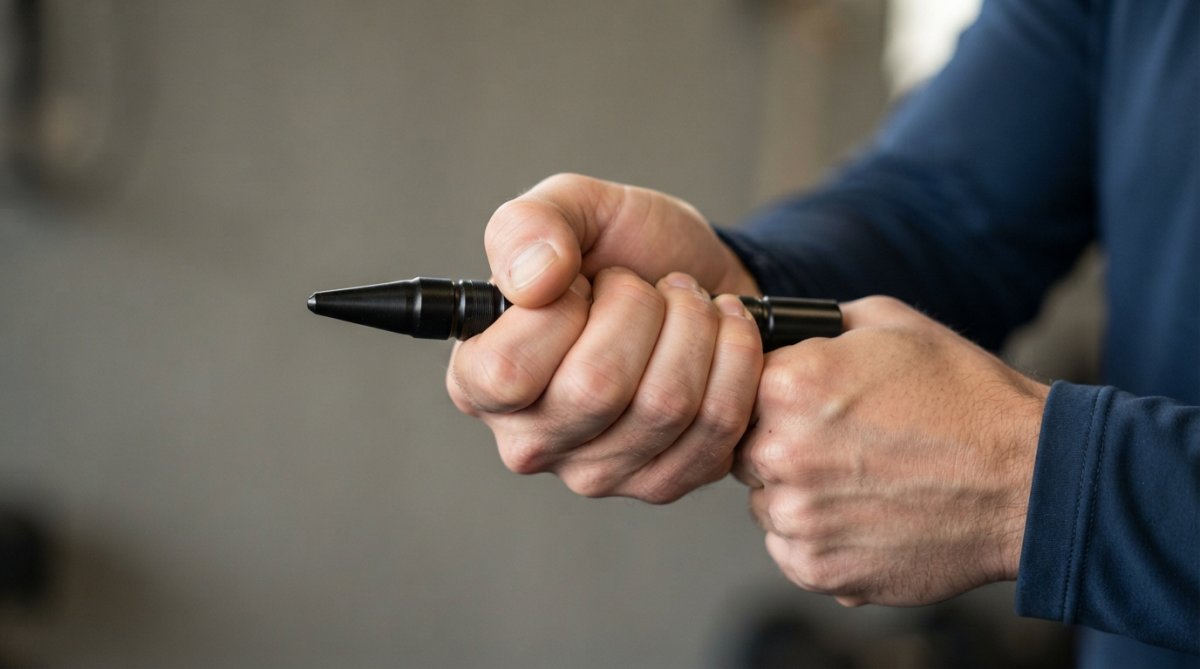
Hold it firmly without tiring your hand. Keep your wrist neutral and let the motion come from your entire arm and shoulder, not just your hand. This distributes force effectively and prevents wrist injury.
The fist grip positions the kubotan along your knuckles inside a closed fist, aligning the striking surface with your knuckles for close-quarters combat.
Practice switching between grips so muscle memory recognizes both positions based on distance and angle. Most people find the hammer fist grip more natural under stress.
Striking Methods and Target Areas
Effective striking targets vulnerable areas with nerve clusters and soft tissue. The hand, wrist, and forearm are most accessible, close to you and easy to hit accurately.
The instep causes immediate pain and brief immobilization, especially effective if grabbed from behind.
The solar plexus (center chest, slightly below the breastbone) disrupts breathing and causes disorientation but requires proper technique and distance.
The inside of the knee and outer shin have minimal bone protection and create significant pain.
Never target the head or spine unless your life is in immediate danger, these carry serious legal and ethical implications. Stick to soft tissue targets. Your goal is escape, not retaliation.
Practice striking from your shoulder with a locked wrist, letting arm weight drive impact. Repetition builds muscle memory for effective execution under stress.
Pressure Point Techniques for Kubotan Use
Pressure points are nerve clusters that respond to targeted pressure. The kubotan's small striking surface is ideal for this, requiring precision more than force.
The inside of the wrist contains pressure points that cause sharp pain and force grip release if someone grabs you.
The hand has sensitive pressure points between the bones that create immediate discomfort and break an attacker's grip.
The neck carries serious legal and safety risks. Target the shoulder or collarbone area instead unless your life is in immediate danger.
The temple and jaw cause disorientation and pain but require close proximity and clear opportunity.
Take a self-defense course covering pressure point locations. Hands-on instruction from a qualified instructor ensures proper technique and appropriate application.
Kubotan Legality by State
Kubotan legality varies by state and local jurisdiction. Unlike firearms, kubotans are governed by a patchwork of state self-defense laws and local ordinances. Understanding your local rules before purchase is essential.
States with no restrictions:
States with conditional restrictions:
States with outright prohibitions:
City and county variations:
TSA and air travel: Federal Transportation Security Administration (TSA) regulations prohibit kubotans in carry-on luggage. Pack your kubotan in checked baggage only. Some airlines may impose additional restrictions beyond TSA rules, so it's wise to contact your carrier before traveling.
Legal liability and use: Carrying a kubotan legally does not justify using it. Self-defense law generally requires force to be proportional and necessary. Using it against an unarmed person or in non-life-threatening situations can have serious legal consequences. It's always advisable to call police immediately after any incident and consult an attorney before making statements.
How to verify your local laws: Contact your state's attorney general office (typically accessible via your state attorney general) or call your local police department's non-emergency line. Provide a description of your kubotan (material, length, design) and ask explicitly whether it's legal to own and carry in your jurisdiction. Request written confirmation if possible. This creates a record if questions arise later.
Aqua Defense Safety Keychain Set with →
Traveling across state lines: Research destination laws before departure. Store your kubotan in a locked container separate from the passenger compartment when driving across state lines.
Drills and Practice Routines to Build Muscle Memory
Building muscle memory requires structured, progressive practice through repetition under realistic conditions. The following drills progress from foundational grip work to scenario-based responses.
Phase 1: Foundational Grip and Form (Weeks 1-2)
Hold your kubotan in the hammer fist grip for 30 seconds, then switch to the fist grip without looking. Repeat 10 times daily for automatic grip switching.
Practice striking motions in front of a mirror at slow speed (one strike every 2 seconds). Focus on shoulder-driven movement with a locked wrist. Perform 20 slow-motion strikes daily. Do not progress to faster speeds until form is consistent.
Benchmark for advancement: You can switch grips smoothly 10 times without hesitation, and your mirror strikes show consistent shoulder-driven motion with zero wrist bend.
Phase 2: Speed and Power Development (Weeks 3-6)
Once form is solid, perform striking motions at normal speed (one strike every 1 second) for 15 strikes, rest 30 seconds, repeat for three rounds.
Practice heavy bag or striking pad 2-3 times weekly, targeting solar plexus, ribs, and legs. Aim for accuracy before speed. Perform 3 rounds of 10 strikes per target zone, resting 1 minute between rounds.
Solo practitioners can use a wall-mounted or free-standing bag, or practice against a padded surface like a pillow held at various heights.
Benchmark for advancement: You complete 15 speed strikes with consistent form, and you hit a heavy bag target zone 8 out of 10 times from various distances.
Phase 3: Distance Recognition and Timing (Weeks 7-10)
Stand 6 feet from a partner (or wall marker) and step forward slowly, noting the distance at which you can strike without overextending. Optimal range is typically 2-3 feet.
Have a partner stand at various distances (3, 5, 8 feet) while you practice stance and movement without contact. Train your brain to recognize effective striking range.
Mark distances on the floor using tape and practice stance and striking motion at each distance to build spatial awareness.
Benchmark for advancement: You can identify your optimal striking range within 6 inches, and you move smoothly between distances without losing balance or form.
Phase 4: Pressure Point Targeting (Weeks 11-14)
Practice applying kubotan pressure to wrist points (inside of the wrist) and hand points (between metacarpal bones). Use minimal pressure to learn location and angle.
Have your partner extend their arm and practice striking the inside of their wrist 10 times, focusing on the same nerve cluster. Repeat on the opposite wrist.
Use a training dummy or your own arm (with extreme caution) and mark pressure point locations with a marker for visual targeting.
Benchmark for advancement: You can locate and strike a pressure point on a partner's wrist 7 out of 10 times without verbal guidance.
Phase 5: Scenario-Based Training (Week 15 onward)
Have a partner approach from the front, side, or behind. Practice defensive responses without contact to train threat recognition and appropriate responses.
De-Escalation and Situational Awareness
Self-defense starts with situational awareness. Pay attention to your surroundings, notice people and vehicles, and trust your instincts.
| Practice Element | Frequency | Duration | Focus |
|---|---|---|---|
| Grip switching drills | Daily | 5 minutes | Muscle memory for both positions |
| Slow-motion striking | Daily | 10 minutes | Proper form and technique |
| Speed striking practice | 3x weekly | 10 minutes | Explosive power development |
| Target practice with bag | 2x weekly | 15 minutes | Accuracy and impact |
| Distance recognition drills | 2x weekly | 10 minutes | Proper striking range |
| Pressure point practice | Weekly | 10 minutes | Nerve cluster targeting |
| Scenario training | Monthly | 20 minutes | Real-world response patterns |
Frequently Asked Questions
Is it legal to carry a kubotan in all states?
Kubotan legality varies significantly by state and sometimes by city. Most states allow them, but some restrict or ban them entirely. Before carrying one, check your specific state and local laws. If you're traveling or moving, verify the rules where you're going. Defense Divas Keychains includes safety items in sets like the Sunflower Defense Keychain Set, but you're responsible for knowing local regulations before purchase and use.
How effective is a kubotan for real self-defense?
A kubotan is a force multiplier that works best when combined with proper training, situational awareness, and de-escalation skills. Its effectiveness depends on your ability to target pressure points and soft tissue areas accurately under stress. It's not a magic solution, muscle memory from consistent practice and understanding when to deploy it make the difference. It's most valuable as part of a broader personal safety strategy, not as a standalone solution.
How often should I practice with a kubotan to develop muscle memory?
Aim for at least 2-3 practice sessions per week to build reliable muscle memory. Each session should include grip drills, target practice on a heavy bag or pad, and pressure point repetition. Consistency matters more than duration, even 15-20 minutes of focused practice beats occasional longer sessions. The goal is to make your response automatic so you can deploy it instinctively if you ever need it in a real situation.
What's the difference between practicing with a kubotan and a tactical pen?
Both are keychain-sized impact weapons, but kubotans are designed specifically for pressure point application and joint manipulation, while tactical pens emphasize striking and penetrating soft tissue. Kubotans offer more leverage for control techniques, making them better for compliance and restraint. Tactical pens are faster for striking. Your choice depends on whether you prefer control-based defense or rapid impact response. Many defense keychain sets include multiple tools to cover both approaches.