

Table of Contents
- 1. Plan Your Route and Check Arrival Times Before You Leave
- 2. Situational Awareness Techniques That Actually Work
- 3. How to Report Suspicious Activity on Public Transit
- 4. Best Self-Defense Accessories for Women on a Nighttime Commute
- 5. Digital Safety and Privacy While Using Public Transit
- 6. Transit-Specific Emergency Protocols for Late-Night Travel
- 7. Accessibility-Focused Safety and Traveling with a Companion
- Frequently Asked Questions
Last Updated: September 19, 2026
1. Plan Your Route and Check Arrival Times Before You Leave
Knowing how to stay safe on public transit at night starts before you ever step onto a platform. Planning your route and checking arrival times ahead of time is the single most effective safety step you can take. This guide from Defense Divas Keychains breaks down the habits that matter most.
A common mistake is deciding your route in the moment. That leaves you waiting on a dark platform with no backup plan. Instead:
- Check your transit authority's app for real-time arrival times before leaving
- Pick a route with fewer transfers, even if it takes a few minutes longer
- Share your route and expected arrival time with an emergency contact
- Identify a well-lit, busy stop near your destination as a backup
Late-night travel gets safer when someone knows where you are. A quick text takes seconds.
2. Situational Awareness Techniques That Actually Work
Situational awareness is the practice of actively noticing what is happening around you instead of drifting on autopilot. On a nighttime commute, it is your first and best layer of protection.
Most guides get this wrong. They tell you to "stay alert" without explaining how.
Try these habits instead:
- Keep your head up and scan the platform every 30 seconds or so
- Note who boards with you and where they sit
- Trust your gut if someone's behavior feels off
- Avoid burying your face in your phone or wearing both headphones
The goal is not paranoia. It is simply knowing your surroundings well enough to react early.
3. How to Report Suspicious Activity on Public Transit
Reporting suspicious activity on public transit means telling the right person quickly, using the tools your transit system already provides. You do not need to be certain something is wrong to speak up.
Here is how to report it:
- Move to a safe, populated area first
- Use the onboard emergency intercom or alert button if you are on a train or bus
- Text your transit authority's security line if one is posted at the station
- Call 911 if someone is in immediate danger
- Describe what you saw, where, and what the person was wearing
Transit security teams would rather hear a false alarm than miss a real one. Suspicious behavior includes someone following passengers, blocking doors, or watching people too closely.
4. Best Self-Defense Accessories for Women on a Nighttime Commute
The best self-defense accessories for women are small, legal, and easy to grab in a hurry. A good set lives on your keys or wristlet, so it is already in your hand when you need it.
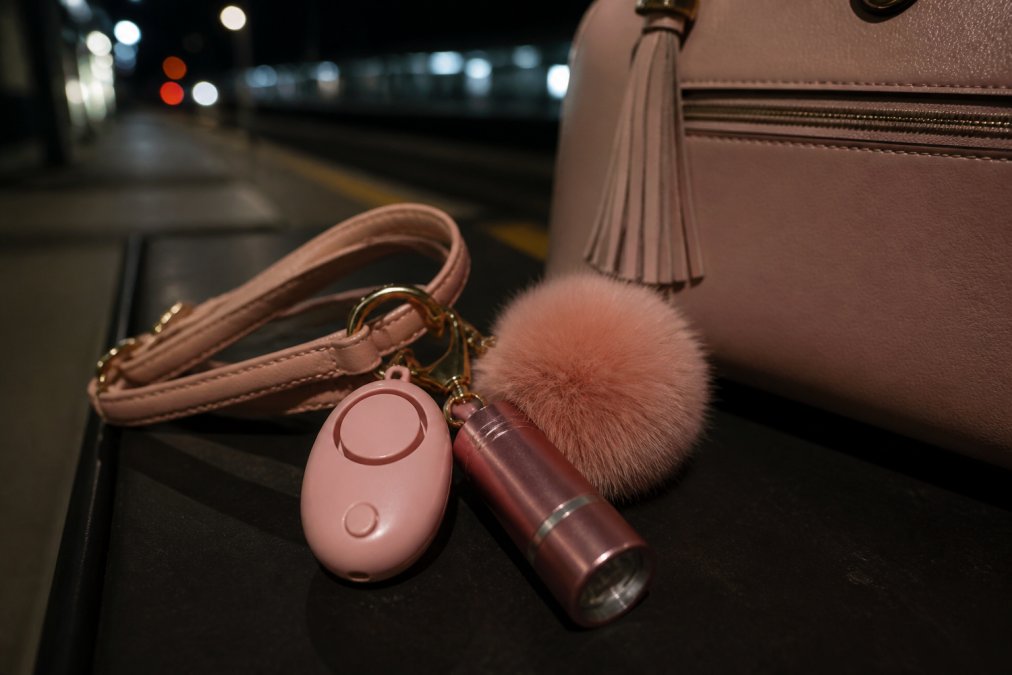
Defense Divas Keychains builds sets that combine practical tools with a look you will actually carry. The Aqua Defense Safety Keychain Set, for example, pairs a personal safety alarm and mini flashlight with a rhinestone pepper spray holder and a matching card holder wallet, all on one wristlet.

| Item | What It Does | Best For |
|---|---|---|
| Personal safety alarm | Attracts attention in an emergency | Drawing eyes to your situation |
| Emergency whistle | Signals for help | Alerting people nearby |
| Mini flashlight | Lights dark platforms and walkways | Late-night stops |
| Seatbelt cutter | Cuts a seatbelt if needed | Rideshare emergencies |
A keychain set does not replace awareness. It gives you a fast option when words are not enough.
5. Digital Safety and Privacy While Using Public Transit
Digital safety matters as much as physical safety on a nighttime commute. Your phone holds your location, contacts, and payment details, and it is the item most likely to be grabbed.
🛡️ School Safety Keychain Set for →
A few habits go a long way:
- Keep your mobile device out of sight when you are not using it
- Turn off location sharing on social apps until you are home
- Use a crossbody bag with a zipper to protect personal belongings
- Never leave your phone on a seat or table
Anti-theft bags and a little vigilance cut down on grab-and-run thefts. If you use ride-hailing, confirm the license plate and driver name before getting in. A licensed cab or verified rideshare is always safer than an unmarked car.
6. Transit-Specific Emergency Protocols for Late-Night Travel
Transit-specific emergency protocols are the steps you take when something goes wrong mid-ride, and they differ from a general street emergency. Knowing them ahead of time keeps you calm.
On a train or bus, remember:
- The emergency intercom connects you directly to the operator
- Emergency exits are marked at the ends of each car
- Pull the emergency brake only in a true emergency
- Move toward the operator's car if you feel unsafe
If you are stranded at a station late at night, stay in well-lit areas near other people. Call a trusted friend or your emergency contact and stay on the line until your ride arrives.
7. Accessibility-Focused Safety and Traveling with a Companion
Traveler safety looks different for riders with disabilities, and a good plan accounts for that. Transit systems offer services that make nighttime travel more manageable.
Many transit authorities provide:
- Paratransit or dial-a-ride options
- Boarding assistance on request
- Priority seating near the operator
If you use a mobility device or have a vision impairment, ask your transit authority what support is available on your route. Traveling with a companion or group is always safer at night, and it is worth adjusting your schedule to ride with someone you trust.
A companion also helps with the small things: watching your belongings, sharing the walk to your stop, and keeping an eye on arrival times together.
Late-night transit does not have to feel risky. With a planned route, real situational awareness, and a few practical tools on hand, you can move through your commute with confidence. Defense Divas Keychains makes that easier with stylish safety keychain sets, including the Sunflower Defense Keychain Set and the Turquoise Cow Print Defense Keychain Set, each pairing a personal safety alarm, mini flashlight, and seatbelt cutter in a design you will want to carry. Explore the full collection and find the set that fits your style.

Frequently Asked Questions
What are the best ways to stay alert while riding public transit at night?
Stay alert by keeping your phone charged and accessible, avoiding headphones that block out all sound, and sitting near the driver or in a well-lit area of the transit vehicle. Situational awareness techniques like scanning your surroundings and noting exit locations help you react quickly if something feels wrong. If you feel drowsy, stand up or move seats rather than closing your eyes.
Are there specific safety accessories that help when commuting at night?
Yes. A personal safety alarm, mini flashlight, and emergency whistle are practical tools that fit easily on a keychain. The Aqua Defense Safety Keychain Set from Defense Divas includes a personal alarm, flashlight, and wristlet for easy carrying. The Sunflower Defense Keychain Set also adds a window breaker and seatbelt cutter. These accessories are designed for everyday preparedness and help attract attention during an emergency.
How can I choose the safest seat on a bus or train after dark?
Sit near the driver or operator when possible, and choose a seat in a well-lit area with clear sightlines to exits. Avoid empty cars or isolated sections. On trains, the car with the conductor or transit staff is usually safest. On buses, the front rows give you quick access to the driver if you need help. Stay visible to others and keep your personal belongings secured in a crossbody bag or on your lap.
What should I do if I feel uncomfortable on public transit?
Trust your instincts. If someone is making you uncomfortable, move to a different seat near other passengers or the driver. You can pretend to take a phone call or use a safety alarm to draw attention. If the behavior continues, report it to the transit operator or use the transit authority's text tip line. Note the time, route, and a description of the person, then contact transit security or local police if needed.