

Table of Contents
- What a Self Defense Kit Actually Includes
- Pepper Spray Laws by State: What You Must Know Before You Carry
- Choosing a Personal Safety Alarm: What the Numbers Mean
- Self Defense Kits for Women: Style That Doesn't Sacrifice Function
- Self Defense Training for Beginners: Tools Are Only Half the Answer
- Maintenance, Expiration, and Testing Your Kit
- How to Build the Right Self Defense Kit for Your Everyday Carry
- Conclusion
Last Updated: August 7, 2026
Building a solid self defense kit is one of the most practical decisions you can make for your personal safety. The difference between a kit that protects you and one that fails comes down to three things: what you carry, whether it's legal where you are, and whether you've practiced with it.
What a Self Defense Kit Actually Includes
A self defense kit is a curated set of non-lethal personal safety tools designed to deter, delay, or incapacitate a threat long enough for you to escape. The best kits combine multiple tool types because no single item covers every scenario. A personal alarm works when you need to draw attention; pepper spray works when you need to create distance; a kubaton works when someone is already in close range.
Pepper Spray and OC Sprays
Pepper spray is the most common anchor tool in any self defense kit. OC spray (Oleoresin Capsicum) causes involuntary eye closure, intense burning, and temporary respiratory distress, creating the window you need to escape. Effective options include sprays with 25 or more bursts and a range of 10 to 16 feet.
When selecting pepper spray, prioritize:
- UV marking dye, which aids law enforcement identification
- A flip-top or twist-lock safety cap to prevent accidental discharge
- A quick-release keychain clip for immediate access
- Compact design that fits in a jacket pocket
Pepper gel formulas work well indoors, with reduced wind blowback compared to aerosol sprays. Check the expiration date on your canister, OC spray degrades over time, and a two-year-old canister may not perform at full strength.
Personal Alarms, Kubatons, and Tactical Flashlights
Personal alarms are universally legal and highly effective. A 120dB to 130dB alarm is audible up to 1,000 feet away. Pull-pin activation means you can trigger it in the dark or with one hand.
A kubaton is a short, palm-length rod (5 to 6 inches) used to amplify strike force to pressure points. Modern designs blend into everyday carry without broadcasting "self-defense tool."
Tactical flashlights serve double duty: a 300-lumen or higher beam can temporarily blind an attacker in low-light conditions, and the hardened aluminum body can function as a striking tool if needed.
Stun Guns, Safety Keychains, and Compact Add-Ons
Stun guns deliver a high-voltage, low-amperage shock that causes immediate muscle disruption. They require direct contact with an attacker, which is their key limitation. The crackling sound and visible arc are themselves deterrents. However, stun guns are banned or restricted in several states and municipalities, check your local laws before purchasing.
A safety keychain set typically bundles several tools into a coordinated carry system: a kubaton or pointed key tool, a small alarm, a wrist strap, and sometimes a window breaker or seatbelt cutter. Everything rides together on one ring, eliminating rummaging in an emergency.
| Tool | Range | Legal in All 50 States | Requires Contact | Best Use Case |
|---|---|---|---|---|
| Pepper Spray | 10-16 feet | No (varies by state) | No | Creating distance from a threat |
| Personal Alarm | N/A (sound) | Yes | No | Drawing attention, deterrence |
| Kubaton / Key Ring | Close range | Mostly yes | Yes | Pressure point strikes |
| Stun Gun | Direct contact | No (varies by state) | Yes | Immediate incapacitation |
| Tactical Flashlight | Close range | Yes | No | Disorienting, striking |
Pepper Spray Laws by State: What You Must Know Before You Carry
Pepper spray laws vary significantly by state, and carrying the wrong canister in the wrong place can result in criminal charges. The general federal rule is that OC spray is legal for adults 18 and older to purchase and carry, but states and municipalities layer their own restrictions on top of that baseline.
States With Restrictions or Outright Bans
A handful of states impose meaningful restrictions:
- Massachusetts: Legal from licensed firearms dealers only; maximum 1.5 ounces
- Michigan: Legal, but maximum 2% OC concentration
- New York: Legal for adults 21 and older; must be purchased from a licensed dealer
- Wisconsin: Legal as combination CS/OC formula; pure OC may be restricted
- Washington D.C.: Legal with registration requirements
Stun guns face stricter restrictions in Hawaii, Rhode Island, and parts of Michigan. These laws change, so verify current status with your state attorney general's office before purchasing.
Traveling Across State Lines and Through Airports
Crossing state lines with a self defense kit requires knowing the laws of every state you'll pass through. At airports, the TSA prohibited items guidelines ban pepper spray from carry-on luggage entirely. It may be transported in checked baggage if the canister is 4 fluid ounces or less with a safety mechanism. Personal alarms are generally TSA-approved for carry-on. Stun guns must be in checked baggage and declared at check-in.
For air travel, carry only universally approved items like a personal alarm, and ship or check everything else.
Choosing a Personal Safety Alarm: What the Numbers Mean
A personal safety alarm requires zero training, zero legal compliance research, and zero maintenance beyond a battery swap. It belongs in every kit regardless of what else you carry.
The decibel rating matters most:
- 85dB: Roughly equivalent to heavy traffic, noticeable but not alarming at distance
- 100dB: Equivalent to a motorcycle, startling at close range
- 120-130dB: Equivalent to a jet engine, causes pain at close range, audible up to 1,000+ feet
Look for pull-pin activation over button activation. Under stress, fine motor skills degrade. A pull-pin is harder to fumble than a small button. Battery type matters too, replaceable LR44 batteries with up to 365 days of standby time mean you're not guessing whether the device is charged.
Self Defense Kits for Women: Style That Doesn't Sacrifice Function
The assumption that personal safety tools must look tactical is outdated. Women's self defense kits now integrate seamlessly into everyday carry without compromising function.

Defense Divas Keychains offers stylish and trendy safety defense keychain sets, often paired with designer-inspired purses or custom trucker hats, perfect for those seeking unique accessories with a Western-inspired flair. We provide a personalized shopping experience, ensuring you have early access to new items through our preorder exclusives, and enjoy the attentive service only a small business can offer. Our customers love the access to trendy accessories and the ability to express their individual style with our unique designs. A tactical-looking stun gun that stays home is less useful than a stylish keychain alarm that's always on your wrist. Consistency of carry beats maximum firepower every time.
What to look for in a women's self defense kit:
- Wrist coil or carabiner clip for quick access
- Coordinated color options that integrate with existing accessories
- Compact dimensions that fit in a coat pocket
- Lightweight construction for small crossbody bags
Defense Divas Keychains offers preorder exclusives that give customers early access to new designs. Visit defensedivas.shop to see current and upcoming sets.
Self Defense Training for Beginners: Tools Are Only Half the Answer
Owning a self defense kit and knowing how to use one are different things. A tool you've never practiced with is a tool you'll fumble under stress. Adrenaline narrows your vision, reduces fine motor control, and shortens reaction time. Repetition makes deployment automatic.
Situational Awareness and Threat Assessment
Situational awareness is continuously scanning your environment to identify potential threats before they escalate. It means:
- Noting exit locations when you enter a new space
- Keeping your phone in your pocket when walking alone
- Trusting your instincts when a situation feels wrong
- Avoiding headphones in both ears in unfamiliar areas
Threat assessment is deciding whether to leave the area, create distance, or deploy a tool. De-escalation is always the first goal. Verbal deterrence combined with physical distance resolves most threatening situations before they become physical.
According to RAINN's safety planning resources, most assaults occur in situations where the victim had prior warning signals that were dismissed. Building the habit of acting on those signals is more protective than any single tool.
Practicing With Your Gear Before You Need It
Self-defense training for beginners starts with ten minutes of deliberate practice at home. Run through this checklist monthly:
- Practice drawing your pepper spray from your bag or clip with both hands
- Practice the thumb-over-top grip for a kubaton or key ring tool
- Pull the pin on your personal alarm to confirm smooth mechanism
- Practice activating your stun gun's safety and trigger sequence in the dark
- Walk through a verbal deterrence script out loud
Many pepper spray manufacturers include free safety training videos with purchase, covering aim, deployment distance, and accidental exposure scenarios.
Maintenance, Expiration, and Testing Your Kit
Most self defense kits fail because the owner never checks them after purchase. Maintenance is the gap between a kit that works and one that doesn't.
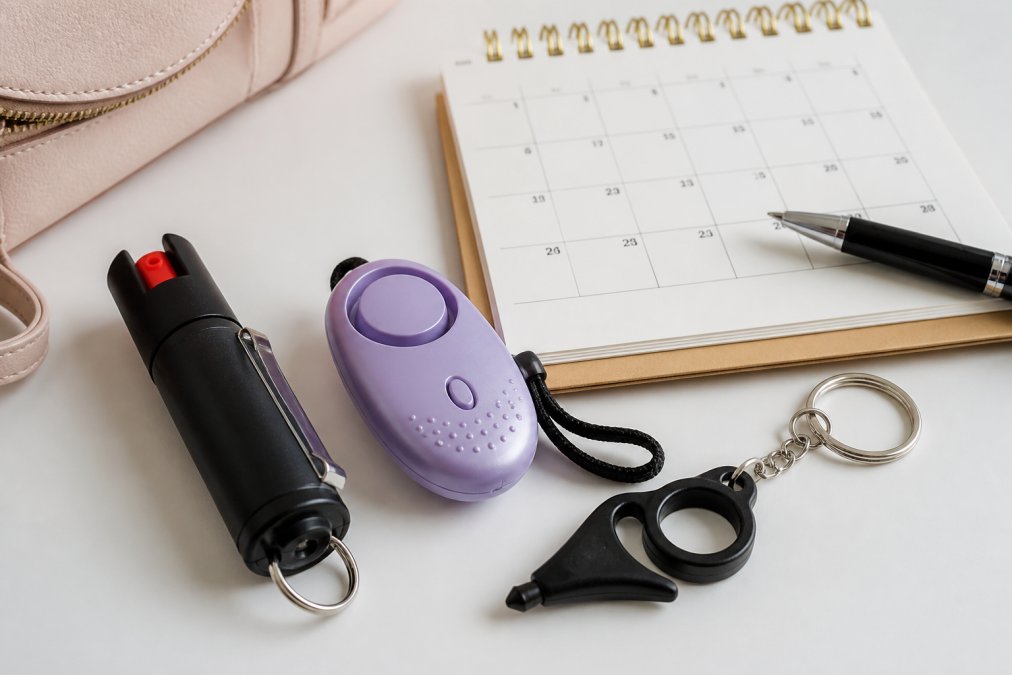
Every tool has a service interval:
| Tool | Check Frequency | What to Check | Replace When |
|---|---|---|---|
| Pepper Spray | Every 6 months | Expiration date, safety mechanism | At expiration or after discharge |
| Personal Alarm | Every 90 days | Battery life, pin mechanism | Battery low or mechanism stiff |
| Stun Gun | Monthly | Charge level, test arc | Battery fails to hold charge |
| Kubaton / Key Ring | Annually | Physical integrity | Visible damage or deformation |
| Tactical Flashlight | Monthly | Charge or battery level | Dim output or failure to activate |
Pepper spray expiration is the most commonly ignored maintenance issue. Most canisters have a shelf life of two to four years from manufacture date. Replace on schedule, an expired canister may spray, but OC concentration degrades, reducing stopping effect.
How to Build the Right Self Defense Kit for Your Everyday Carry
Building a self defense kit comes down to three variables: your lifestyle, your legal environment, and your comfort level with each tool.
Start with what's universally legal and simple: a personal alarm. That's your foundation.
Layer from there based on your situation:
For urban commuters and college students: Add pepper spray (check campus policy) and a safety keychain with a kubaton. Keep it clipped to a bag strap or wrist coil for accessibility.
For women traveling alone: Prioritize a personal alarm and compact pepper gel for indoor environments. Carry a window breaker and seatbelt cutter in your car.
For everyday carry in a permissive state: A full kit might include pepper spray, personal alarm, stun gun, and tactical flashlight on a single keychain. Redundancy ensures if one tool fails, another covers the gap.
For travel: Strip the kit to TSA-compliant items (personal alarm only in carry-on) and check or ship everything else.
A stylish keychain will "actually stop someone" depending on the tool, situation, and whether you've practiced. A 130dB alarm won't physically incapacitate anyone, but it will startle, attract attention, and disrupt the attacker's plan. The combination of tools, training, and awareness creates real protection.
Defense Divas Keychains preorder exclusives let you get coordinated keychain sets before they sell out. Visit defensedivas.shop to see current and upcoming sets.
Frequently Asked Questions
What items should be in a basic self-defense kit?
A solid self defense kit typically includes at least one non-lethal deterrent and one alerting tool. The most common combination is a pepper spray and a personal safety alarm. From there, many people add a kubaton or impact keychain for close-range situations, and a tactical flashlight for low-visibility environments. The right mix depends on your daily routine, the states you travel through, and how much you want to carry. Compact design and quick-access placement matter as much as the tools themselves.
Is it legal to carry pepper spray in every state?
Pepper spray is legal in all 50 states, but the restrictions vary significantly. Some states cap canister size, limit OC concentration, or require the carrier to be over 18. New York, California, Massachusetts, and Michigan have some of the strictest rules. A few states restrict certain formulas entirely. Always check the specific pepper spray laws for your state and any state you plan to visit before you carry. TSA prohibits pepper spray in carry-on bags, though checked baggage rules allow small canisters under specific conditions.
What is the most effective non-lethal self-defense tool?
There is no single answer because effectiveness depends on the situation and the user. Pepper spray is widely considered the most practical everyday carry option: it works at a distance, requires minimal training, and is legal almost everywhere. Personal alarms are universally legal, including on airplanes, and the loud siren can deter an attacker and draw help quickly. Stun guns provide direct incapacitation but require close contact and are restricted in several states. The best tool is the one you have with you, know how to use, and can access in under three seconds.
Are self-defense keychains legal in all US states?
Most keychain-style tools, including personal alarms and basic kubatons, are legal in the majority of states. However, some states and cities classify certain impact tools or weighted keychains as prohibited weapons. California, for example, restricts some kubaton-style devices. Stun gun keychains face restrictions in states like Hawaii, Rhode Island, and parts of Michigan. Before buying any self defense kit, verify local laws for every item in it, especially if you are moving to a new state or traveling frequently.
How do I choose the right self-defense kit for my lifestyle?
Start with where you spend most of your time. College students and urban commuters often prioritize compact, discreet tools that fit on a keychain or inside a small bag. Women who travel frequently benefit from a personal safety alarm since it clears TSA without issue. If you commute alone at night, a pepper spray with a 10- to 16-foot range adds meaningful distance between you and a threat. Think about quick-access placement, your state's legal restrictions, and whether you are willing to practice with the tool. A self defense kit you actually carry beats a comprehensive one left at home.
A self defense kit is only as effective as the person carrying it, and most people underestimate how much preparation matters. Defense Divas Keychains offers stylish safety keychain sets that make consistent carry realistic for women who want protection without sacrificing personal style. Browse coordinated sets featuring kubatons, alarms, and compact safety tools, and sign up for preorder access to new designs before they launch.