

Table of Contents
- Why Discreet Self Defense Matters When You Walk Alone After Dark
- Personal Safety Keychain Sets: Small Tools, Real Deterrents
- How to Use a Safety Keychain Under Stress
- Safety Tips for Walking Alone at Night
- Discreet Carry Methods That Keep Tools Accessible
- Legal Compliance by Jurisdiction: What to Check Before You Carry
- After an Incident: Post-Incident Protocol and Reporting
- Frequently Asked Questions
Last Updated: September 19, 2026
Why Discreet Self Defense Matters When You Walk Alone After Dark
Walking to your car after a late shift, crossing a dim parking lot, or cutting between the bus stop and your front door: these are the moments where discreet self defense for walking alone at night becomes practical. Discreet self defense means carrying low-profile tools that look like ordinary accessories, so you stay prepared without advertising that you are armed.
Personal Safety Keychain Sets: Small Tools, Real Deterrents
A personal safety keychain set is a cluster of small emergency tools, typically a personal alarm, mini flashlight, seatbelt cutter or window breaker, and sometimes a pepper spray holder, on one ring you can grab in a second.
What Belongs on a Safety Keychain
The most useful sets share core components:
- Personal safety alarm to attract attention and interrupt an approach
- Mini flashlight for dark sidewalks, stairwells, and parking garages
- Emergency seatbelt cutter or window breaker for vehicle emergencies
- Pepper spray holder for those who carry spray and live where it is legal
- Wristlet strap so the set sits in your hand, not buried in a bag
Aqua Defense, Sunflower, and Emerald Sets Compared
Defense Divas Keychains carries several coordinated sets that differ mainly in what is included.
| Set | Price | Standout Components | Best For |
|---|---|---|---|
| Aqua Defense Safety Keychain Set with Wallet | $44.99 | Alarm, mini flashlight, rhinestone pepper spray holder, wristlet, card holder wallet | Matching your purse and carrying cards in one piece |
| Sunflower Defense Keychain Set | $27.99 | Alarm, mini flashlight, window breaker/seatbelt cutter, stylus pen | Everyday carry on a budget |
| Emerald Cowhide Safety Defense Keychain Set | $58.99 | Alarm, pepper spray holder, seatbelt cutter, emergency whistle, cow print wristlet pouch | Western style and the fullest tool lineup |
| School Safety Keychain Set | $18.95 | Alarm, whistle, seatbelt cutter, hand sanitizer bottle | Students, teens, and backpacks |
How to Use a Safety Keychain Under Stress
Knowing how to use a safety keychain matters more than owning one. Under stress, fine motor skills drop, so the pull-tab alarm you can find by feel beats the tool you have to look down to operate.

Deployment Speed and Muscle Memory
Deployment speed comes from repetition, not the tool. Practice pulling your alarm pin with keys already in hand, the same way every time, so your body learns the motion.
- Practice the pull motion with the set already in your palm
- Rehearse while walking, not standing still
- Test your alarm's sound monthly so you know it works
- Keep the set in the same pocket or wrist every time
Safety Tips for Walking Alone at Night
Situational awareness does more work than any tool. Threat assessment starts before anything happens: notice who is behind you, which streetlights are out, and where open businesses are.
- Keep one earbud out, or both, so you hear footsteps and voices
- Walk in the street-facing lane of the sidewalk, not against a wall
- Trust the uneasy feeling and change direction toward people and light
- Have your keys and safety set out before you leave the building
- Tell someone your route and expected arrival time
- Skip the shortcut through the unlit lot, even when it saves five minutes
Discreet Carry Methods That Keep Tools Accessible
Discreet carry means your protection does not announce itself but is still reachable in one motion. Concealment and access are not in conflict if you choose the right spot.
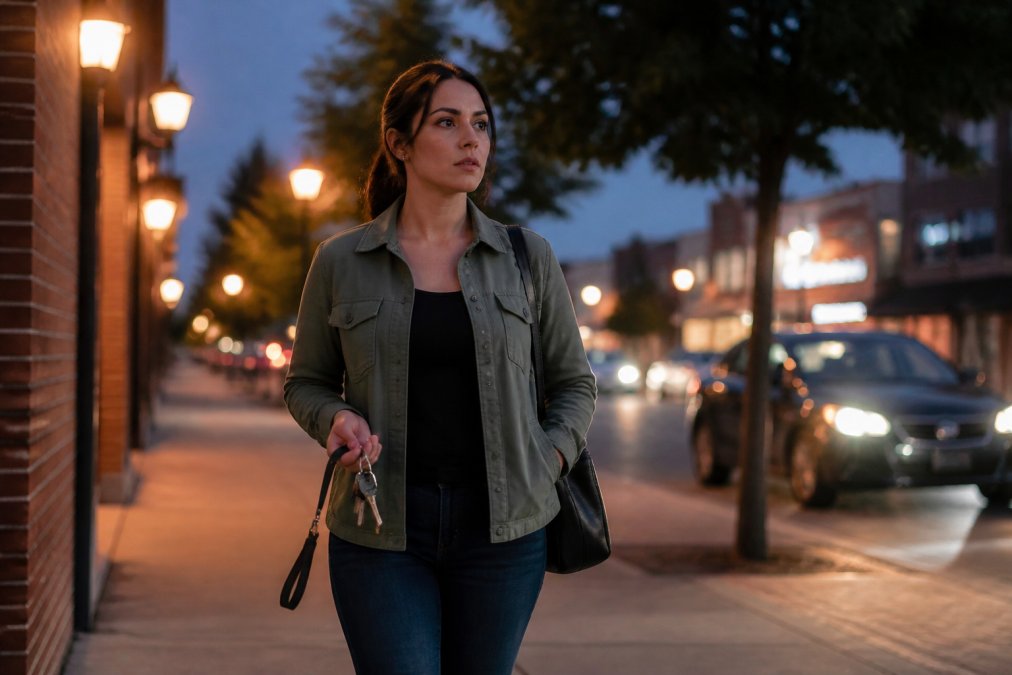
Three carry methods that work in practice:
- Wristlet in hand: looped on your wrist with keys, so it reads as a normal accessory
- Outer jacket pocket: no zipper, no flap, hand rests there naturally
- Crossbody bag front pocket: accessible without swinging the bag around
Legal Compliance by Jurisdiction: What to Check Before You Carry
Self-defense tool laws vary by state, city, and sometimes building. A canister legal at your front door may be restricted at your office, campus, or the airport you fly through next month. Compliance is your responsibility, so check the rules where you actually carry.
The Three Layers of Rules That Apply to You
Most people check one layer and stop. In practice, three layers stack, and the most restrictive wins.
- State law: sets the baseline for pepper spray, stun guns, Tasers, batons, and knives. Some states preempt local rules entirely; others let cities add restrictions on top.
- City and county ordinances: can ban or limit items the state allows, and can regulate carry in specific zones like transit stations or entertainment districts.
- Property and facility rules: schools, courthouses, airports, federal buildings, and many private employers prohibit defensive tools regardless of state law. These are not criminal statutes in most cases, but violating them can get you trespassed, fired, or escorted out.
What Actually Varies, Item by Item
The categories below are where the real differences live. Treat them as questions to answer for your state, not legal advice.
- Pepper spray: Some states cap canister size, restrict concentration, require a permit, or limit online purchase and shipping. A few require a minimum distance or prohibit certain spray patterns. A handful restrict carry in specific public places even when the canister itself is legal.
- Stun guns and Tasers: A number of states and cities restrict or prohibit civilian possession, and some require a permit or a background check. Taser-brand devices and generic stun guns are sometimes treated differently under the same statute.
- Knives: Blade length, blade type (fixed vs. folding), automatic-opening mechanisms, and concealed-carry rules all vary. What is a legal pocket knife in one state can be a prohibited weapon in another.
- Batons, kubotans, and impact tools: Frequently overlooked. Some jurisdictions classify these as prohibited weapons even when they look like ordinary keychain accessories.
- Personal alarms and whistles: Generally the least regulated category, which is one reason they are the safest default for travel and for anyone unsure of local rules.
How to Actually Check Your Rules
A five-minute check beats a guess:
Aqua Defense Safety Keychain Set with →
- Search your state's official legislature or attorney general website for the statute covering the specific item (for example, the section on "weapons" or "dangerous instruments").
- Check your city and county code for any ordinance that adds restrictions on top of the state rule.
- If you work on a campus, in a federal building, or for an employer with a written policy, read that policy separately, it often bans items the state allows.
- If you fly, check the current transportation security rules for the item before you pack it, and plan to leave restricted items at home rather than surrender them at a checkpoint.
- If you cross state lines regularly, re-check for each state you carry in. A tool that is fine at home can be a citation or an arrest two hours away.
A Practical Default for Travel and Uncertainty
When you do not know the local rules, the lowest-risk choice is a personal alarm, whistle, and bright flashlight. These are least likely to be restricted anywhere, draw attention rather than escalate, and travel well. Save pepper spray, stun device, and knife decisions for places where you have confirmed the rules.
After an Incident: Post-Incident Protocol and Reporting
Almost no guide covers what happens after you use a defensive tool. The minutes and hours after an incident shape whether you are treated as a victim, a witness, or a suspect. The steps below are ordered for a reason: safety, then medical, then documentation, then the report.
Step 1: Get to Safety and Call for Help
Move to a populated, well-lit place first. If there was any physical contact, threat, or weapon, call 911. Give the dispatcher your location, what happened, and a description of the person if you have one. Stay on the line until told to hang up.
Step 2: Get Medical Attention, Even If You Feel Fine
Adrenaline hides injuries. A grab, fall, or strike can leave bruising, a sprain, or a concussion you do not notice until the next day. Accept a medical evaluation if offered, or seek one yourself. If exposed to your own pepper spray, follow the product's decontamination guidance and tell the provider what you used.
- Get checked for injuries you may not feel yet
- Tell the provider what tool you used, if any
- Ask for documentation of any visible injuries
Step 3: Preserve Evidence and Write Down What You Remember
Memory fades fast and details blur within hours. Write down what you remember while it is fresh, in your own words, before talking to anyone else.
- Time, location, and direction of travel
- What the person looked like, wore, said, and did
- What you said and did, in order
- Which tool you used, how, and how many times
- Names and contact info for any witnesses
Step 4: Report to Police, Even If Nothing Was Taken
A report creates a record. Records shape patrols, connect your incident to others, and support charges if the person is caught later. You do not need to be certain a crime occurred to file one, describe what happened and let officers sort out the classification.
When you talk to officers:
- Describe honestly what you did, including any tool you used
- Stick to what you remember and say so when you are unsure
- Ask for the report number and the officer's name and badge number
- Ask how to get a copy of the report for your records
Step 5: Protect Yourself Legally and Emotionally
The legal aftermath can be as stressful as the incident itself. A few steps reduce risk:
- Do not post about the incident on social media. Anything you post can be used later.
- Do not contact the other person, directly or through someone else.
- If you are contacted by an investigator or an attorney, you can decline to answer questions until you have spoken with your own attorney.
- If charges are filed against you, or if you are unsure whether they might be, consult a criminal defense attorney in your state before giving a formal statement.
- Tell someone you trust, and arrange not to walk home alone for a while.
Follow-Up in the Days After
A report is not the end. In the days that follow:
- Follow up with the assigned detective or officer if you have not heard anything
- Request a copy of the report for your own records
- Keep a simple log of any related contact, sightings, or concerns
- Check in with a medical provider if new symptoms appear
- Consider a counseling or victim-services resource if the incident is affecting sleep, work, or your sense of safety
Frequently Asked Questions
What is the most effective discreet self defense tool for walking alone at night?
There is no single best tool, but a personal safety alarm paired with a keychain set covers the most ground. A high-decibel alarm draws attention and can startle an assailant, while the keychain keeps tools like a mini flashlight or pepper spray holder within reach. Defense Divas keychain sets bundle these items so nothing gets left behind. Practice pulling the alarm and flashlight from your bag under low light so you build muscle memory before you need it.
Is it legal to carry self defense keychains?
Legality depends on your state and city. Some jurisdictions restrict pepper spray, stun guns, or certain self-defense tools, while personal alarms and whistles are generally allowed. Defense Divas includes a disclaimer reminding buyers to check local, state, and federal laws before purchasing. Before you carry a safety keychain, look up your state's rules on self-defense devices and any municipal restrictions. If you travel or move, verify the rules in the new jurisdiction before you pack the set.
How can I stay safe while walking alone at night?
Stay aware of your surroundings, keep your phone accessible, and avoid distractions like headphones. Walk in well-lit areas and tell someone your route. Carry a discreet self defense tool you have practiced using, such as a safety alarm or keychain set. If you feel uneasy, trust that instinct and move toward people or a business. De-escalation and distance are your first line of defense; tools are a backup for when those fail.
What should I look for in a discreet self defense kit?
Look for tools that are easy to access under stress, legal in your jurisdiction, and small enough to carry daily. A good kit includes a personal alarm, a flashlight, and a holder for pepper spray if allowed. Defense Divas sets like the Aqua Defense or Sunflower options bundle these into a wristlet or keychain you can clip to your bag. Test the alarm volume, check the flashlight battery, and practice grabbing the set without looking.