

Table of Contents
- Do Self-Defense Keychains Actually Work in Real Situations?
- Pepper Spray Keychain Effectiveness: What the Evidence Shows
- Stun Gun Keychain Effectiveness: Electrical Shock Delivery and Limitations
- What to Put on a Safety Keychain for Maximum Utility
- Self-Defense Keychain Legality: Know Your Local Laws
- Critical Limitations: When Self-Defense Keychains May Not Be Enough
- Building a Layered Safety Strategy Beyond Your Keychain
- Frequently Asked Questions
Last Updated: October 6, 2026
Do Self-Defense Keychains Actually Work in Real Situations?
The short answer: it depends on the tool, your training, and the situation. Whether self-defense keychains work depends on these factors, as these keychains mix devices, some genuinely effective, others mostly psychological comfort.
At Defense Divas Keychains, we help women find personal safety tools that fit their lifestyle. The question we hear most: do these tools deliver in a real threat?
What Self-Defense Keychains Contain
A typical set bundles personal alarms, flashlights, pepper spray holders, and window breakers. It's less about one "magic tool" than layered options, the alarm to draw attention, the flashlight to see and be seen, the pepper spray for distance, the window breaker if you're trapped in a vehicle. The advantage is accessibility: these tools live on your keys, so they're with you when you walk to your car, travel, or commute.
Why Effectiveness Depends on the Tool Type
Not all tools perform equally. A flimsy alarm won't produce enough sound to be useful. Old or temperature-exposed pepper spray loses potency. A well-made tool from a reputable source has been tested; a cheap knockoff might fail exactly when you need it.
Pepper Spray Keychain Effectiveness: What the Evidence Shows
Pepper spray is one of the most researched self-defense tools, irritating the eyes, nose, and throat to cause temporary blindness and difficulty breathing. Studies on law enforcement use show it incapacitates around 80-90% of subjects when applied to the face, but that's in controlled conditions with trained users.
In real-world situations, several factors reduce effectiveness:
- Distance matters. Pepper spray works best within 6-12 feet. Beyond that, wind carries it away or disperses it. You need to be close enough to aim.
- Wind and weather affect it. Windy conditions blow the spray away from your attacker and potentially back toward you. Rain reduces concentration.
- Aim under stress is difficult. In a panic, most people don't aim well. Spraying wildly wastes the canister.
The real advantage of pepper spray is distance: you don't have to be within arm's reach, so you can deploy it and create space to escape.
Stun Gun Keychain Effectiveness: Electrical Shock Delivery and Limitations
The advantage of a stun keychain is that it's compact and legal in most areas. The disadvantage is the close-contact requirement, which puts you in immediate danger.
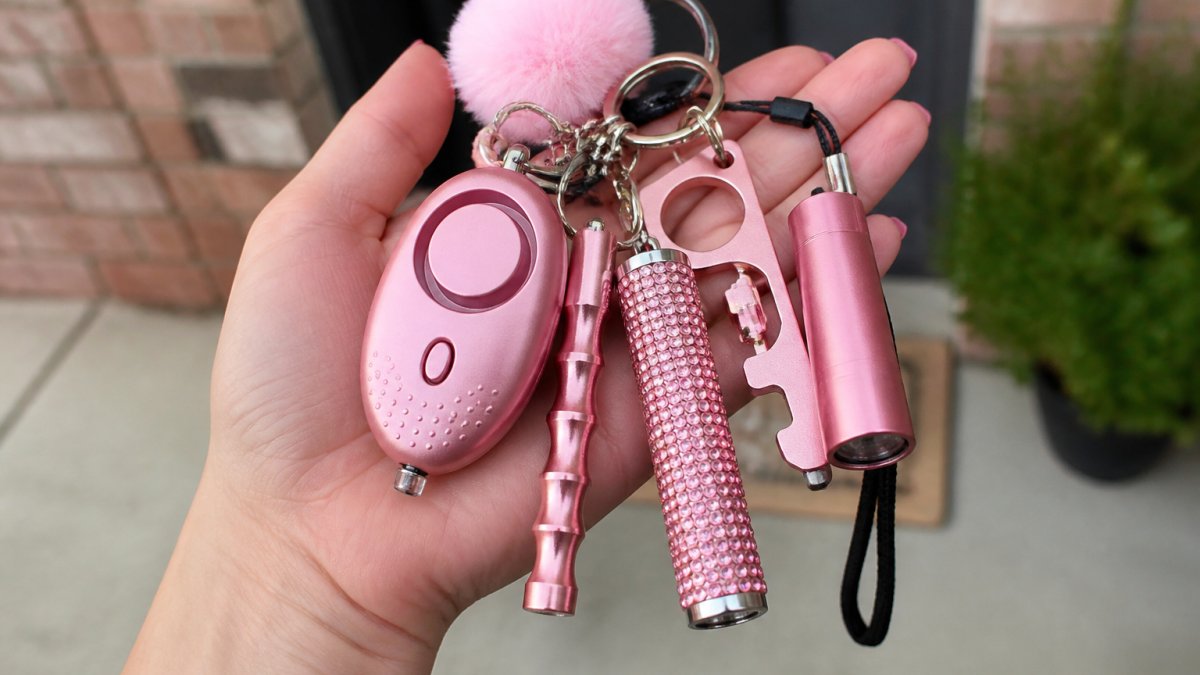
What to Put on a Safety Keychain for Maximum Utility
The best safety keychain isn't one tool but a combination that gives you options based on threat level. Start with these essentials:
- Personal alarm. A loud alarm (120+ decibels) draws attention and often stops an attacker who wants to avoid witnesses. It's effective, legal everywhere, and requires no training. This should be your first line of defense.
- Flashlight. A small LED flashlight serves dual purposes. It helps you see your surroundings and temporarily disorients an attacker if shined in their eyes. It's also useful for practical needs like finding your keys.
- Window breaker or seatbelt cutter. If you're trapped in a vehicle, this tool becomes critical. It's one of the few tools that serves a specific, high-stakes purpose.
The Defense Divas Sunflower Defense Keychain Set ($27.99) includes an alarm, flashlight, window breaker, and wristlet, a practical starting point. The Aqua Defense Safety Keychain Set with Wallet ($44.99) adds a matching wallet and accessories. Don't overload your keychain: too many tools make it heavy, bulky, and hard to deploy under stress. Three to five core tools are enough.

Self-Defense Keychain Legality: Know Your Local Laws
This is the part most guides skip, and it can turn a safety tool into a criminal charge. Self-defense tools are regulated at three overlapping levels, and a tool that's fine at home can be a problem one town over.
The Three Layers of Rules That Apply
Federal law. No federal statute specifically bans carrying pepper spray, personal alarms, or stun devices for personal defense, but carrying any self-defense tool into a secure area of an airport, federal courthouse, or post office is prohibited, and some tools are restricted on federal property regardless of state law.
State law. This is where most of the variation lives. States fall into roughly four buckets for each tool type:
- Unrestricted, no permit, no age limit beyond general minority rules, no capacity limit.
- Age- or capacity-limited, legal to possess but with a minimum age (commonly 18) or a maximum canister size.
- Permit or registration required, legal only with a license, firearms permit, or registration.
Local ordinances. Cities and counties can be stricter than the state. A tool that's legal statewide may be banned inside a specific city limit, on public transit, in schools, in bars, or in government buildings.
Tool-by-Tool Reality Check
-
Personal alarms. Not classified as weapons in any state we're aware of; some venues (courthouses, airports, some schools) prohibit them as noise devices.
-
Flashlights and window breakers. Treated as tools, not weapons, in most jurisdictions, though a window breaker with an exposed spike may be classified as a weapon in a few.
-
Pepper spray. Legal in all 50 states in some form, but details vary widely. Common restrictions include minimum age (often 18), maximum canister weight (often 2 to 4 ounces for civilian carry), concentration limits on the active ingredient, and outright bans on concealed carry in a handful of jurisdictions. Some states require a permit or a firearms license to carry.
-
Impact tools (kubotans, spike keychains, baton-style keychains). Frequently classified as concealed weapons or prohibited weapons. A keychain that looks like a cat face may be treated as brass knuckles in some jurisdictions. This is the category where the gap between 'sold online' and 'legal to carry' is widest.
A Practical Legality Checklist
Before adding any tool to your keychain, run this checklist:
- Identify the exact tool. 'Pepper spray' isn't specific enough. Note the active ingredient, concentration, canister size, and whether it's a stream, fog, gel, or foam.
- Search your state's statutes. Use your state legislature's official site and search 'pepper spray,' 'self-defense spray,' 'electronic weapon,' 'stun gun,' and 'concealed weapon.' Read the definitions section, that's where the classification lives.
- Check your city and county code. Municipal codes are usually online. Search the same terms plus 'weapons' and 'dangerous instruments.'
- Check transit, school, and workplace rules. These are often stricter than the surrounding jurisdiction and enforced separately.
- Confirm age and permit requirements. If a permit is required, find out how to get one and how long it takes.
- Check travel destinations. If you fly, drive across state lines, or visit another city, the rules change at the border. TSA rules also apply at checkpoints.
- Re-check periodically. Self-defense laws change. A tool legal two years ago may not be today, and vice versa.
Where to Verify
- Your state legislature's official statute database.
- Your state attorney general's office, which often publishes consumer guidance on self-defense products.
- Your city or county clerk or municipal code portal.
What Happens If You Use a Tool Illegally
The legal risk isn't just possession. Using a self-defense tool beyond what your jurisdiction allows can expose you to civil liability and criminal charges, even if you were the one attacked. Self-defense law generally requires your response be proportional to the threat and that you reasonably believed force was necessary; a tool that's illegal to carry weakens that position before you reach the self-defense question.
Critical Limitations: When Self-Defense Keychains May Not Be Enough
Here's what most marketing won't tell you: a self-defense keychain is a tool, not a force field. Its limits are predictable, and understanding them separates a useful safety plan from false security.
Aqua Defense Safety Keychain Set with Wallet →
Stress Response and Training Requirements
Under extreme stress, your body shifts into a survival state: heart rate climbs, breathing gets shallow, and blood flow moves toward large muscle groups. The consequences for a keychain tool are specific:
- Fine motor skills degrade first. Gripping a small canister, finding the safety tab, or pressing a recessed button gets harder, not easier, when your hands are shaking.
- Tunnel vision narrows your options. You may not notice the tool on your keyring even though you've carried it for months.
- Time distortion. An encounter that lasts a few seconds can feel like minutes, which makes 'just deploy the spray' sound simpler than it is.
Training closes the gap. Even basic, repeated practice, drawing the tool, disengaging the safety, aiming, and stepping off-line, builds the motor pattern you'll fall back on. Without it, you're relying on instinct, which under stress defaults to freeze, flight, or flailing.
Size and Strength Mismatches
A keychain tool is designed to interrupt an attack long enough to escape.
-
Reach matters. Pepper spray gives you distance, but only within its effective range. Impact tools require you to be within arm's reach, already the danger zone.
-
Grip matters. Small keychain tools are easy to fumble and easy to have taken away. A tool that ends up in the attacker's hand is worse than no tool at all.
Escalation Risks
Using any self-defense tool escalates a situation. That's the point, but escalation cuts both ways.
- Visible weapons can provoke. An attacker who sees you reaching for a weapon may respond with more force than they would have otherwise.
- Failed deployment can embolden. If your spray misfires or your stun device doesn't connect, you've signaled that you're fighting back without changing the attacker's capability.
- Legal escalation. Even a justified use of force can lead to a police report, an investigation, and civil exposure.
De-escalation, talking, creating distance, drawing attention, often works better than confrontation. But if it fails and you must act, a keychain tool can create the opening to escape. The goal is escape, not victory.
Failure Modes You Should Plan For
Tools fail. The question is whether you've planned for it.
- Battery failure. Alarms and flashlights die; a dead alarm is a plastic brick.
- Expiration. Pepper spray has a shelf life of typically a few years, the active ingredient degrades and the propellant can lose pressure. Check the date.
- Temperature exposure. A canister left in a hot car or freezing trunk can lose pressure and spray pattern.
Maintenance and Readiness
A keychain tool is only as good as its last check. Build a simple routine:
- Monthly function check. Test the alarm, click the flashlight, confirm the spray nozzle isn't clogged.
- Check expiration dates. Replace pepper spray before it expires, not after.
- Inspect for damage. Look for cracks in the housing, bent clips, or corrosion on contacts.
- Confirm accessibility. Can you deploy it in under two seconds without looking? If not, reposition it.
- Replace batteries on a schedule. Don't wait for a failure to remind you.
- Re-train after any change. A new tool, bag, or carry position resets your muscle memory.
When a Keychain Is Not Enough
Some situations have no keychain answer: an armed attacker, multiple attackers, a threat at a distance, or a medical emergency. Then the correct response is escape, distance, calling for help, and avoiding the encounter in the first place. A keychain tool is one layer, never the only layer.
Building a Layered Safety Strategy Beyond Your Keychain
Real personal safety isn't about one tool.
Layer 1: Awareness. Know your surroundings. Avoid high-risk situations when possible.
Layer 2: Prevention. Walk with purpose. Use well-lit routes.
Layer 3: Tools. A keychain set provides options if prevention fails.

Layer 4: Training. Know how to use your tools.
Layer 5: Escape. The goal isn't to fight.
Most people focus only on Layer 3, the tools.
Frequently Asked Questions
Are self-defense keychains worth it?
Self-defense keychains offer real value as part of a layered safety strategy, but they work best when paired with situational awareness and de-escalation skills. Tools like alarms and flashlights are highly accessible and low-risk. Pepper spray can be effective under specific conditions, but effectiveness depends heavily on proper training, stress response, and proximity to the threat. They are most valuable as deterrents and escape aids rather than as guarantees of safety.
Is it illegal to have a self-defense keychain?
Legality varies significantly by state and even by city. Pepper spray is legal in most states but restricted in some (California, New York, Massachusetts). Alarms and flashlights are legal everywhere. Before purchasing any self-defense keychain, verify the laws in your specific state and any state you travel to frequently. Check local ordinances if you live in a major city, as some municipalities have additional restrictions.
Do pepper spray keychains work in real situations?
Pepper spray keychains can be effective when deployed correctly at close range (4-8 feet), causing temporary blindness and respiratory irritation that allows escape. However, wind direction, attacker tolerance, and user stress response all affect real-world performance. Studies show effectiveness is highest when users have trained with the tool beforehand. Keychain versions hold less volume than larger canisters, reducing margin for error.
What should you keep on a safety keychain?
An effective safety keychain combines low-risk and higher-impact tools: a personal alarm (loud, no legal restrictions), a flashlight (disorientation and visibility), a window breaker or seatbelt cutter (emergency escape), and optionally pepper spray if legal in your area and you've trained with it. The Sunflower Defense Keychain Set ($27.99) includes alarm, flashlight, window breaker, and card holder, covering essential everyday safety without legal complexity. Pair any keychain tool with situational awareness and de-escalation practice for best results.