

Table of Contents
- Quick Comparison: What to Look for in a Reliable Safety Keychain
- Key Factors That Make a Safety Keychain Reliable
- Safety Alarms vs. Physical Defense Tools
- Can You Take Safety Keychains on Airplanes? TSA Rules Explained
- Legal Self-Defense Keychains by State: What You Need to Know
- Training and Muscle Memory: Making Your Keychain Second Nature
- Psychological Impact and De-Escalation
- Frequently Asked Questions
Last Updated: September 20, 2026
Quick Comparison: What to Look for in a Reliable Safety Keychain
A reliable safety keychain is a compact, keyring-mounted set of personal safety tools, typically combining an audible alarm with everyday accessories, that keeps protection within reach without weighing down your bag. This guide from Defense Divas Keychains covers the build quality, deployment, legal, and training factors that separate a genuinely useful safety keychain from a decorative one.

A tool you fumble with under stress is a tool that fails you. Below: what to check before you buy, plus the state-by-state legal questions most buyers never ask.
| Factor | What to Check | Why It Matters |
|---|---|---|
| Build quality | Reinforced keyring, sealed alarm housing | Cheap hardware snaps or jams when pulled |
| Deployment | One-hand grip, quick-release clip | Seconds lost fumbling = lost opportunity |
| Alarm volume | Audible alarm, easy panic button | Draws attention, may deter an attacker |
| Legal status | State and local restrictions | Some components are restricted by state |
| Training | Muscle memory through repetition | Untrained tools get dropped or misfired |
Key Factors That Make a Safety Keychain Reliable
Reliability comes down to three things: hardware that survives daily abuse, a design you can operate without looking, and components that do one job well. Most failures trace back to cheap keyring hardware or an alarm button too small to find under pressure.
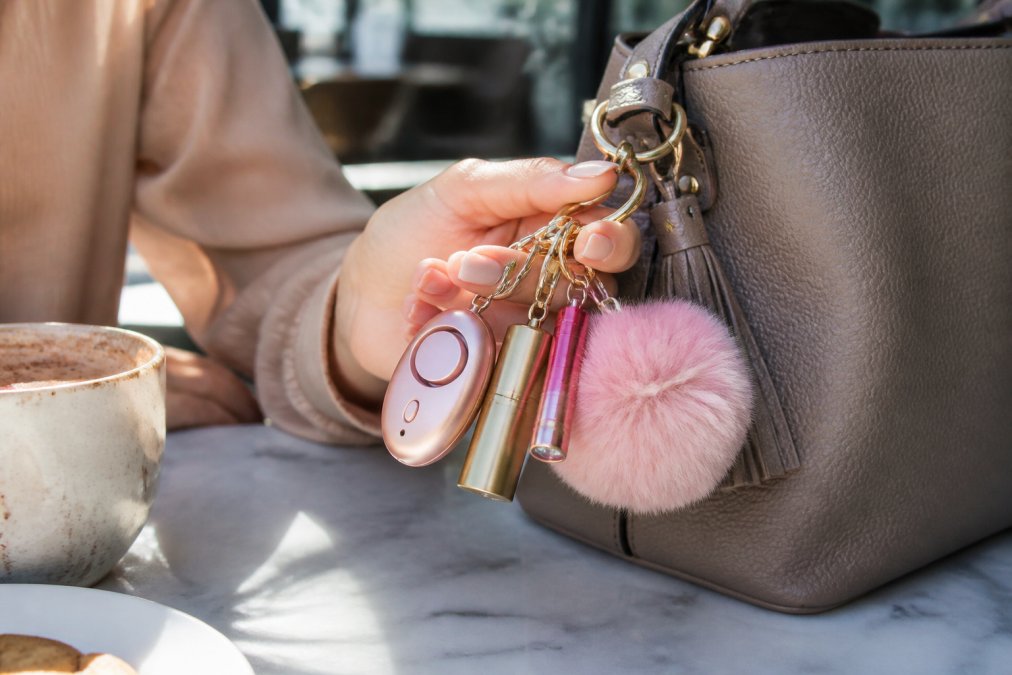
Build Quality and Durability
Check the keyring attachment first. A reinforced, heavy-duty ring holds up to constant handling, while thin decorative rings bend or snap within weeks. Sealed alarm housings resist moisture and pocket lint, which kills most battery-operated units prematurely. Look for sets that use durable key ring hardware throughout rather than mixing sturdy and flimsy pieces.
Ease of Access and Deployment
Deployment means getting the tool into your hand and activated in one motion. A wristlet strap or clip lets you carry the set on your wrist or bag strap instead of buried in a pocket, and the panic button should be large enough to find by touch alone. This is where most sets fail: the alarm works on a table, but the button is too recessed to trigger when your hands are shaking.
Safety Alarms vs. Physical Defense Tools
Audible alarms and physical defense tools solve different problems, and most reliable sets include both. An emergency alarm draws attention and may cause an attacker to disengage; physical tools like a window breaker or seatbelt cutter handle specific scenarios such as vehicle escape.
- Audible alarm: draws attention, may deter, works from a distance
- Window breaker/seatbelt cutter: vehicle emergency escape
- Pepper spray holder: carries a separate defense tool (spray sold separately)
- Mini flashlight: visibility and threat assessment in dark areas
Can You Take Safety Keychains on Airplanes? TSA Rules Explained
- The canister holds 4 fluid ounces (118 mL) or less by weight.
- The active ingredient is a 2% or lower concentration of CS or CN tear gas.
- The canister has a positive means of preventing accidental discharge, such as a locking cap or safety clip.
- It is packed in a checked bag, never a carry-on.
| Item in your set | Carry-on | Checked bag |
|---|---|---|
| Personal safety alarm (no aerosol) | Yes | Yes |
| Mini flashlight | Yes | Yes |
| Keyring hardware, wristlet, pom attachment | Yes | Yes |
| Pepper spray, 4 fl oz or less, 2% CS/CN, with safety lock | No | Yes, with restrictions |
| Pepper spray over 4 fl oz or above 2% concentration | No | No |
| Kubotan or impact tool marketed for self-defense | Varies by screener | Varies by screener |
One more layer: TSA sets the floor, not the ceiling. Individual airports and some states add their own restrictions, and a tool that clears federal screening can still be illegal at your destination. Before you fly, check both the federal rule above and the state law where you are landing, the next section walks through how.
Legal Self-Defense Keychains by State: What You Need to Know
Legal self-defense keychains by state vary widely, and no single set is legal everywhere. Most guides stop there and tell you to "check your state." More useful is knowing which categories of tool trigger restrictions, which states are the outliers, and the three questions to answer before you buy.
Aqua Defense Safety Keychain Set with →
The four tool categories and how they are regulated
1. Pepper spray and OC/CS aerosol. Legal in all 50 states in some form, but rules differ on canister size, concentration, who may buy it, and where it can be carried. A few states require a permit or a minimum age above 18. Several restrict carry in schools, courthouses, government buildings, and some public transit systems regardless of state law.
The three-question legal checklist
Before you buy any set, answer these for your state, your county, and your city:
- Is pepper spray restricted? Check canister size limits, concentration caps, age minimums, permit requirements, and prohibited locations. Your state attorney general or state police website is the authoritative source.
- Are impact tools classified as weapons? Search your state's criminal code for "kubotan," "impact weapon," or "dangerous weapon" and read the definition, not a blog summary. If the statute names the item, treat it as prohibited.
- Does a local ordinance add stricter rules than the state? Cities and counties can be stricter than the state, never looser. Check your city code separately, especially if you live near a school, transit hub, or government building.
The rules that change when you cross a line
- Travel sets should be alarm-only. If you fly or drive across state lines regularly, keep a second set with no aerosol and no impact tool. It is legal in every state and removes the need to research before every trip.
- Moving changes your legal set. If you relocate, re-run the three-question checklist. A pepper spray canister that was legal in your old state may exceed the size limit in your new one, and an impact tool that was fine may be a prohibited weapon.
This is also why training matters. A tool you are not sure you can legally carry is a tool you will hesitate to use. The next section covers building the muscle memory that makes deployment automatic.
Training and Muscle Memory: Making Your Keychain Second Nature
A safety keychain only works if using it is automatic. Muscle memory comes from repetition: practice gripping the set, finding the panic button, and activating the alarm the same way every time, a few times a week until it's reflex. Most people never do this, which is why tools get dropped or fumbled when needed.
Psychological Impact and De-Escalation
The loudest tool in your set is often the most effective, because noise changes the attacker's calculus. A piercing alarm draws attention, creates witnesses, and removes the element of surprise, frequently enough to end an encounter before it escalates. That psychological deterrent is a real function, not a consolation prize.
- Awareness: notice your surroundings before a threat develops
- Avoidance: leave or reroute when something feels wrong
- De-escalation: use voice and distance to defuse
- Deterrence: the alarm as a loud, attention-drawing response
Frequently Asked Questions
What features make a safety keychain truly reliable?
A reliable safety keychain combines durable hardware with easy access. Look for a heavy-duty keyring, a personal alarm, and a compact design that fits your hand comfortably. Quick-release clips and ergonomic wristlet straps help you deploy the alarm without fumbling. Defense Divas sets like the Sunflower Defense Keychain Set include a personal alarm, mini flashlight, and emergency window breaker, giving you multiple non-lethal options in one compact accessory.
Are self-defense keychains legal to carry in all states?
No. Legal self-defense keychains by state vary widely. Some states restrict or ban items like kubotans, tactical pens, or pepper spray, while others allow them with no permit. For example, New York and Massachusetts have stricter rules on pepper spray and impact tools. Before you buy, check your state and local laws, especially if you commute across state lines or are moving. Defense Divas includes a disclaimer reminding buyers to verify local, state, and federal regulations. When in doubt, a personal alarm is the most universally legal option.
Can you take safety keychains on airplanes?
It depends on what's in the set. TSA allows personal alarms and mini flashlights in carry-on bags, but pepper spray is prohibited in carry-on and only allowed in checked bags with strict limits. Window breakers and seatbelt cutters are generally permitted in checked luggage but may be flagged in carry-on. To avoid confiscation, pack the alarm and flashlight in your carry-on and place any pepper spray or impact tools in checked baggage. Always check the TSA website before flying, as rules can change.
How do you test the durability of a safety keychain?
Start by inspecting the keyring and clips for sturdy metal construction, not flimsy plastic. Give the alarm a test pull to confirm it sounds clearly and the pin resets properly. Check that the wristlet strap feels secure and won't tear under pressure. A good rule is to practice deploying your keychain a few times a week so you know exactly how it feels and works before you ever need it in a real situation.