

Table of Contents
- What You'll Need Before Starting Self-Defense Keychain Training
- Understanding the Legal Status of Self-Defense Keychains
- Grip and Deployment Fundamentals for Self-Defense Keychain Training
- How to Use a Kubotan Keychain for Effective Defense
- How to Practice Self-Defense at Home
- De-Escalation vs. Physical Defense
- Building Situational Awareness and Threat Detection
- Frequently Asked Questions
Last Updated: October 3, 2026
What You'll Need Before Starting Self-Defense Keychain Training
Self-defense keychain training requires the right gear and mindset, but no expensive equipment or gym membership, most of what you need is already at home.

Start with a quality self-defense keychain. At Defense Divas Keychains, we design sets that combine safety tools with everyday style. The Sunflower Defense Keychain Set includes a personal alarm, flashlight, and window breaker, everything beginners need to practice safely. Each tool serves a purpose during training and real-world situations.
A practice partner helps you drill safely, though a mirror works if training alone to watch your grip and stance.
Clear your training space. You need at least six feet of open room. Remove breakables and sharp edges. Wear comfortable clothes that let you move freely. Avoid loose jewelry that could catch on your keychain.
Mental preparation matters most: self-defense keychain training builds confidence and muscle memory to deploy your tool quickly, not to make you a fighter.
Understanding the Legal Status of Self-Defense Keychains
Legal restrictions vary dramatically by state and city, what's legal in one place may be prohibited in another. Research your local laws before purchasing or carrying any self-defense tool.
State-Level Restrictions on Common Keychain Tools
Personal alarms and flashlights are legal nationwide, but other keychain tools face significant restrictions:
Pepper spray is legal in most states with limits. California, Hawaii, New York, and Massachusetts restrict potency or require permits; New Jersey bans it entirely. Container sizes are often limited to 2% by mass or less, and legality changes across state lines.
Kubotans and pointed tools are restricted in several states: New York classifies them as prohibited weapons, Massachusetts bans them, California restricts design, and Illinois limits size. A legal tool in your home state may result in criminal charges across state lines.
Window breakers and striking tools are generally legal, but context matters. A keychain window breaker is legal; a similar tool marketed as a "self-defense weapon" may not be, depending on your state's language around "weapons" versus "emergency tools."
How to Research Your Specific State's Laws
Contact your state attorney general's office or local police non-emergency line to confirm what's legal to carry in your jurisdiction. Don't rely on product descriptions or online forums.
Document your state's specific restrictions and keep this record with you, it protects you legally and shows good-faith compliance if questioned by law enforcement.
TSA and Air Travel Rules
If you travel by air, TSA rules supersede state laws. Most self-defense keychains cannot go through airport security in carry-on bags. Personal alarms, window breakers, and kubotans are prohibited in carry-on luggage. Pepper spray is prohibited in both carry-on and checked baggage, with rare exceptions for one 2% by mass aerosol self-defense spray in checked luggage only, and only if it's equipped with a safety mechanism to prevent accidental discharge.
Flashlights are allowed in carry-on bags. If your keychain includes only a flashlight and personal alarm, you can travel with it. If it includes pepper spray or a striking tool, leave it at home or ship it to your destination separately.
Concealed Carry and Permit Requirements
Some states require permits to carry certain self-defense tools. Florida, for example, requires a permit to carry pepper spray. Other states allow open or concealed carry of self-defense keychains without permits. A few states have no restrictions at all.
If your state requires a permit, obtain it before training. Permits are typically inexpensive (under $50) and fast to obtain (usually within days).
Document Your Compliance Before Training
Create a written record of your research date, legal tools, and sources. Keep it with your keychain or phone. This proves good-faith compliance and prevents accidentally carrying illegal tools.
Your keychain is only effective if legal to carry. Illegal tools become evidence against you, not tools for defense.
Grip and Deployment Fundamentals for Self-Defense Keychain Training
Finding Your Natural Grip
Your grip is everything in self-defense keychain training: weak grips waste time and reduce effectiveness, while strong grips give control and confidence.
Hold your keychain in your dominant hand with fingers wrapping naturally around the tool. Your grip should feel stable but not tense.
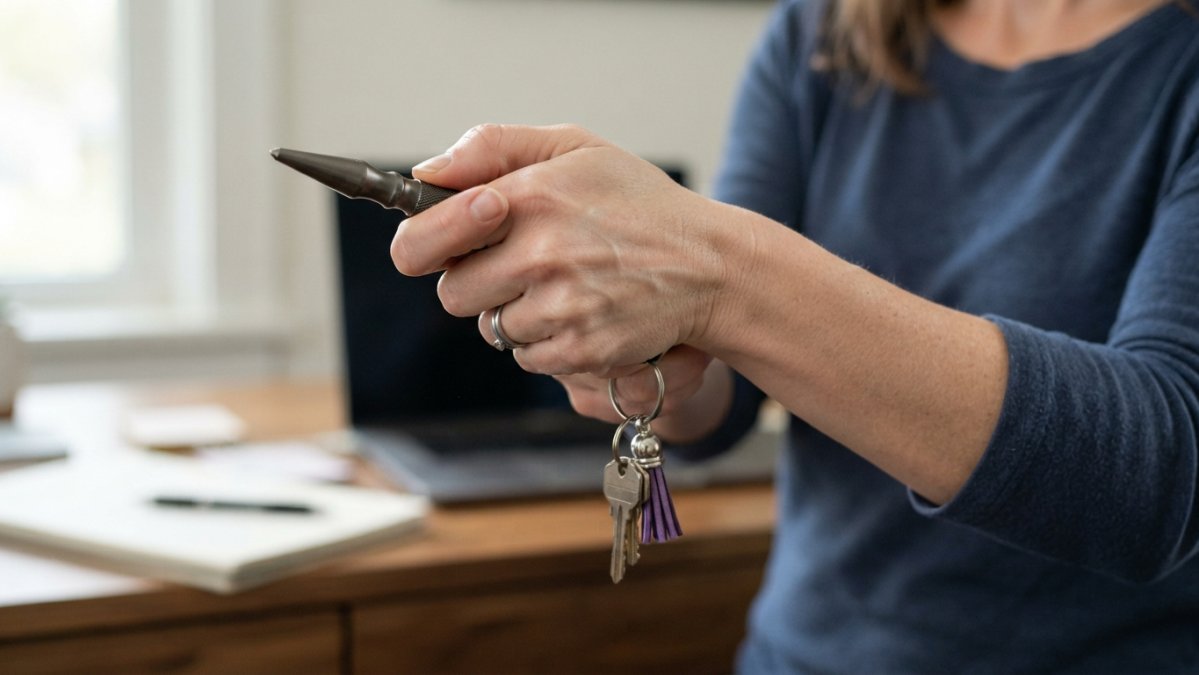
Have your practice partner try to pull the keychain away. If it slips, adjust your finger position so your thumb supports the underside while fingers curl around the top.
Practice your grip five minutes daily while watching TV or reading to build automatic muscle memory.
Deployment Speed Drills
Deployment speed is critical, you need to get your keychain ready in seconds, not minutes.
Keep your keychain where you actually carry it. On a timer, pull it out and get into grip position. Aim for under two seconds; most beginners start at three to five seconds.
Do ten reps three times per week. You'll see improvement within two weeks and hit your two-second target by week four.
Practice deployment from different positions: sitting, walking, and with one hand occupied (phone, bag). Real emergencies don't happen in ideal conditions.
How to Use a Kubotan Keychain for Effective Defense
A kubotan is a small, hard tool that fits on your keychain and looks decorative. It's effective because it focuses force on small areas, creating pain without permanent injury by targeting pressure points.
Pressure Point Targeting
Never practice striking pressure points on a real person. Use a heavy bag or pad to protect your partner and practice with full force.
Aqua Defense Safety Keychain Set with Wallet →
Striking Techniques and Body Mechanics
Practice slow strikes first, focusing on form. Speed comes later; poor form practiced fast builds bad habits.
How to Practice Self-Defense at Home
Structured Muscle Memory Progression for Beginners
Muscle memory develops from structured, progressive repetition.
Week 1: Grip Familiarity (5 minutes daily), Carry your keychain in your pocket or bag. Every two hours, pull it out and place it in your grip position (10 times per day). By week's end, your hand will recognize the tool's shape and weight, and your grip will feel less awkward.
Week 2: Deployment Speed Baseline (3 sessions per week), Set a timer and pull your keychain from your pocket or bag into grip position (10 reps per session, varying positions). Most beginners start at 3-5 seconds; track every time. By week's end, your average should drop to 2.5-3.5 seconds.
Week 3: Deployment Under Distraction (3 sessions per week), Practice five deployment drills in each scenario: sitting, holding a phone, holding a bag, walking, and wearing a jacket. Times will be slower; you're building neural pathways for realistic conditions. By week's end, average deployment should be 2-3 seconds across all scenarios.
Week 4: Pressure Point Targeting and Integration (3 sessions per week), Do five deployment drills followed by five slow-motion strikes to a heavy bag, targeting pressure points (back of hand, inside wrist, thumb-forefinger tissue). Focus on form and body mechanics. By week's end, deploy in under 2 seconds and transition to targeting smoothly.
Tracking Progress and Adjusting Your Schedule
Keep a training log noting date, drill, times, and how movements felt. After four weeks, review for progress.
Common Mistakes to Avoid During Training
Inconsistent practice is the biggest mistake. Commit to three sessions per week minimum; skipping more than one week loses progress.
Practicing too hard, too fast causes fatigue and bad habits. Keep your grip firm but relaxed; if your forearm feels fatigued after practice, you're gripping too hard.
Skipping the fundamentals is the third mistake. Master grip and deployment first; spend at least two weeks on these before adding pressure point targeting.
Practicing alone without feedback slows progress. Use a training partner, mirror, or video to catch form errors and stay accountable.
Not varying your practice scenarios limits your readiness. If you only practice while standing in an empty room, you won't be prepared to deploy while sitting, walking, or distracted. Vary your position, your environment, and your circumstances. Practice in different clothes. Practice when you're tired. Practice when you're stressed. This builds real-world readiness.
When to Increase Difficulty
Once you can deploy in under 2 seconds consistently (across all scenarios), you're ready to add complexity. This might include:
- Practicing while your eyes are closed (simulating low-light conditions)
- Practicing while someone is verbally distracting you
- Practicing after physical exertion (doing 20 pushups, then deploying)
- Practicing with your non-dominant hand
- Practicing while moving backward or sideways
Each of these adds a layer of realism. Don't add all of them at once. Add one new variable every two weeks. This prevents overwhelming your nervous system and keeps progress steady.
De-Escalation vs. Physical Defense
Not every threat requires physical defense. De-escalation is often your best option. It keeps you safe without physical contact.
De-escalation means using words and body language to calm a situation. Speak in a calm voice. Keep your distance. Don't make aggressive gestures. Many situations resolve without ever reaching for your keychain.
However, some situations escalate too quickly for de-escalation. A sudden attack or immediate threat requires physical defense. This is where your keychain training matters.
Know the difference between these scenarios. Train for physical defense. Practice de-escalation in daily life. Most confrontations end with words, not tools. But you need both skills.
Your self-defense keychain is a last resort. Use your voice and awareness first. Use your tool only when physical defense is necessary.
Building Situational Awareness and Threat Detection
Situational awareness is your first line of defense. Most attacks target people who seem unaware. People looking at their phones. People lost in thought. People not paying attention.
Stay aware of your surroundings. Notice who's near you. Notice exits and safe spaces. Notice changes in behavior around you. This awareness prevents most dangerous situations.
Threat detection means recognizing signs of danger before it happens. Someone following you. Someone blocking your path. Someone approaching too quickly. These signs give you time to move away.
Trust your instincts. If something feels wrong, it probably is. You don't need a logical reason to move away from a person or situation. Your gut reaction is often correct.
Practice situational awareness daily. When you're walking, look around. When you're in a store, notice the exits. When you're waiting somewhere, observe the people around you. This habit becomes automatic.
Self-defense keychain training for beginners isn't complicated, but it requires commitment. You need the right tool, consistent practice, and honest assessment of when to use physical defense versus de-escalation. Defense Divas Keychains makes training easier with stylish, functional safety tools that you'll actually want to carry. The Aqua Defense Safety Keychain Set with Wallet gives you everything you need, a keychain tool, personal alarm, flashlight, and the confidence that comes from knowing you're prepared. Start with the fundamentals, practice regularly, and your muscle memory will develop naturally.

Frequently Asked Questions
Is it illegal to have a self-defense keychain?
The legal status of self-defense keychains varies by state and local jurisdiction. Most states allow personal safety keychains, but some restrict specific features like pepper spray or impact weapons. Before purchasing or carrying any self-defense keychain, check your state and local laws. Some items are prohibited on airplanes by the TSA, so always verify regulations where you live and travel. When in doubt, contact local law enforcement or your state's attorney general office for clarification.
Do self-defense keychains actually work in an emergency situation?
Self-defense keychains are non-lethal tools that can be valuable as part of a broader personal safety strategy that includes situational awareness and de-escalation skills. Regular practice at home builds confidence and reflexive response. They're most valuable as a deterrent and a tool to create distance between you and a threat, allowing time to escape.
How do you properly hold a self-defense keychain?
Proper grip is essential. Hold the keychain firmly in your dominant hand with your fingers wrapped securely around it, keeping your thumb on top for stability. The striking surface should face outward, ready for deployment. Practice this grip repeatedly until it becomes second nature. Your grip should feel comfortable enough to maintain control but firm enough to deliver force if needed. Muscle memory drills help ensure you can achieve this grip quickly under stress.
What's the best way to practice self-defense keychain techniques at home?
Start with slow, controlled movements to build proper form and body mechanics. Practice your grip, deployment, and striking motions in front of a mirror to check alignment. Perform repetition drills daily: draw and deploy 10-20 times, focusing on speed and consistency. Practice situational scenarios like retrieving your keychain from a bag or pocket. Build muscle memory through consistent, deliberate practice. Gradually increase speed as your technique improves.